We have no hidden agendas here, nor make money off of anything we do, nor ask for donations. We respect and defend all wildlife and all other animals as well — and Defend them We will, for as long as the senseless, contrived, and greed situation kills our Wildlife and other animals !!!!!!! This is a response to Oregon’s Department of Fish and Wildlife in their awkward and no-scientific attempts to De-List the Wolf from the ESA!
TO: Oregon Department of Fish and Wildlife
Regarding: Delisting of Wolves in Oregon State
We, and the organization I represent, cannot and will not support your decision of De-Listing the Wolves within Oregon State. Our organization is made of Life-Long Oregonians and others raised within the Northwest; which, is made of Vietnam Veterans as well as all other wars since then – and we, as Oregonian’s – Veterans – and American’s, are concerned with your decision making process.
We find no valid references to validate your questions placed within your decision making process, as they are in particular non-scientific as well as Special Interest driven.
What we have found is validity in those particular questions used in many other states to make awkward and non-scientific decisions, primarily based on — no science what so ever, all of them listed. We have also found evidence, and reference material from the Legislative Branch of our Federal Government, those particular questions were developed from those who specifically (and well noted as well as emotionally driven) hate Wolves, and gathered a consortium to change the Endangered Species Act over the years.
We Oregonian’s find this situation in contempt, and ironically hypocritical. I say this, as at previous ODFW meetings and presentations, you lectured the public on emotion-driven situations and forethought, and yet your decisions are based not on science, but the emotional aspects of Special Interest Groups; which in turn is driven mostly from fear, which caters toward contempt and hatred, which extends further into bad decision making = quite Costly to all Taxpayer’s in the State of Oregon . . .
We also see, under review and closer scrutiny, your Special Interest slant very obvious and devious in nature and character. In reality your decisions to Delist the Wolves, with such a non-viable population that exists currently, it is definitive in responsive-action toward those Special Interest Groups only, as mentioned above.
Oregonian’s seem to be left out of the equation in total, and in reality pay the most in taxpayer money for you to manage Oregon’s Wildlife. And, as you also know — if not Oregon needs a change of Administration within the ODFW immediately — Oregonian’s receive the least amount of benefit when compared to the actuality of taxes being paid for such endeavors, to the ODFW presently that only caters for a small minority of the pubic.
We also cannot locate any references to validate the questions posed for the decisions, and find them irresponsive to Oregonians wants and requirements to manage Oregon’s Wolves. We also discovered, as well as researched, with no emotion from us but certainly of concern, the ODFW’s attachment to such a government agency as Wildlife Services, under the cloak of USDA. So within the question’s responded to for your decision making process, the element of trust is null and void, as your association with Wildlife Services (references apparently you neglected to notice below) speaks loud and clear to the public-at-large in Oregon.
Please peruse below the overwhelming amount of references of psychopathic behaviors of Wildlife Services employees, the long stream and consistent through the years of animal torture and abuse, then the in particular non-management, and totally in opposition to any type of management of wildlife, especially in Oregon, the Millions of Wildlife tortured and Killed over the Decades by this particular government agency . . .
Abuse, torture, and the killing of animals recklessly as well as uselessly, in this case wildlife, is not what Oregonian’s pay you for! Your direct association with such a government agency, and those types of individuals, is not only questionable, but unacceptable.
The fact is, you have been blessed with a public that has been asleep over the past few decades, especially in the matters of wildlife management, and many other states and wildlife management organizations have gotten away with a lot of Special Interest tragedies. That no longer will exist, as the Public is, and will in the future become very responsive to those situations I have pointed out above.
I think an example is in order here – the killing of calves and cows recently, supposedly attacked by a wolf in Klamath County, will serve us well in questioning the situation, and the ODFW response. Proximity is not an assurance of guilt of an attack by a wolf, especially since we have good information it was not in that area at the time of the supposed attack; especially near the ranch and grazing range in question.
But how profound, a week before a purposeful Special Interest Delisting of the Wolf, that it would happen – the problem is, it was not wolves or wolf, but we see quite a few other wildlife in that particular area that can and would be confused with a wolf – so, as an Oregonian and concerned citizen, I would strongly suggest more investigation into this matter. We need quality in our wildlife management, not frivolous non-science backed by only torture and abuse of our wildlife here in the State of Oregon . . . and this is what Oregonian’s take pride in, Our Wildlife and Natural Environment . . .
Further Aspects of Discussion
Ironically, during my discussions the terms “good science”, “emotion”, “data gathering”, among others, strike aggressively toward a condescending subjective-reasoning, in that the ODFW wants to change factual presentation to nothing more than an emotional response; thereby, emotion not used within any of this context what so ever, simply good science and well referenced science, indeed, science, which stands in direct opposition to what ODFW states as their science, which is certainly questionable at best.
Yes, many use these terms within the wrong context, oddly within a derogatory methodology, especially toward those who question their authority and decisions – some realize this, others simply repeat the terms as someone else has applied them, with no idea how out-of-place their reasoning becomes.
When it comes to two terms as “emotion” versus “ignorance” when discussing the preservation of our nation’s wildlife, certainly a vast difference present, with the definition of each making this apparent. We have nothing to hide, most of us that is; but others . . .
Using the Oregon Department of Fish and wildlife, as the minority of state population of ranchers and hunters do, indiscriminately kills native carnivores in a misguided attempt to protect game and livestock. But the scientific fact remains, and the above situation simply ignores detrimental environmental consequences.
For example and well referenced, eliminating carnivores can wreak havoc on ecosystems because small mammal density can surge, and these animals may carry disease and compete with game species for food. Herbivore numbers may also grow unchecked, leading to over-browsing and overgrazing. The use of such other organizations as Wildlife Services remains simply unacceptable to a majority of this State’s population, no matter how perceptions are attempted to change minds. So our endeavors in Oregon should simply remain with nature. Also the stopping of what is an unacceptable practice, and stop such other organizations as Wildlife Services and their kill-at-will paradigm, mostly based on a ranchers or farmer’s emotion of paranoia and what may happen – but is not backed by science or truth – simply falsehoods that generate dead wildlife.
We would like to have several questions answered in the matters of ODFW Science: We find the science incomplete. Lack of data, lack of proper counts of both wolves and cougars, and deficient reasoning toward even the assumption of Delisting of the Wolf as an Endangered Species – i.e. from your document perused, “Recovery of wolf populations in Oregon raises questions regarding wolf impacts on elk and mule deer populations, livestock depredation, and interspecific competition between wolves and cougars. . .”
- The fact is you do not take into consideration, or include Poaching Data within Oregon State, nor do you consider Highway Kills et al, which both remain an extremely significant piece (e.g. large numbers ungulates killed yearly), of data to leave out of any basic research, as well as the matter of especially in the matters of de-listing the wolf from the ESL;
- From observations here in the N.W. and in particular Oregon State, we have found the Cougar and Wolf do not intermix, and actually avoid one another. We have found only 1 Cougar Kill that was covered/stored, and taken by Wolves, and nothing more – no signs of problems at that site – but, we remain finding more poaching kills (bullet holes as well as arrows not retrieved and animals bled-out slowly – as well as both Cougar and Wolf signs on 85% of the poached-killed deer and elk), than we have found cougar and wolf kills, i.e. separately combined – why is this data not combined with your study data, as your study data is incomplete without this information, and many times the poaching kills are available and in-sight and no difficult to see or locate what so ever;
- When you give data such as a percentage of dynamic related to the Cougar and Elk ratio for example, and then make statements of questionable deduction, that there is no proper counts of either cougar or elk, then how in the world do you come up with the percentages? Averaging in wildlife situations, has been found extremely and subjectively counter-productive, and we find this with the wolves also (our counts much different than ODFW, and subjectivity as well as bad counts hamper the studies of both wolf and cougars in Oregon;
- As life-long taxpayers in Oregon and in the N.W., we find the averaging principles of subjective counts next wot worthless, and a waste of the taxpayer dollars, combine this with lack of data, and misrepresenting wildlife situations such as wolves and cougars, then we find no legitimate reasoning toward neither budget nor management controls appropriate – as it is simply bad or misrepresented information is all, and quite costly;
- We understand there may be a serious Conflict of Interest situation within the ODFW and a federal government agency called the USDA — Wildlife Services (this can also be taken to Federal as well as State Court as a criminal action as well if what we gathered within our information is correct, and the state should pursue this situation, as other questionable circumstances also exist), in the matter of relative or family status conflicts– and or retirement at Administrative or Supervisory levels of each government, and conflicts between private commercial/non-commercial agents and state ODFW employees – both are now compromised, and regardless of the relationship, Conflicts of interest between the policy making venues, and or voucher process or contracting when relationship discovered, require curtailment immediately . . .
Wildlife Services
This we find has, and continues, to our understanding, the likelihood of erroneous as well as mismanaged wildlife situations within the State of Oregon, and the major population of Oregon does not and will not put up with the abuse, torture, and useless killing of our State’s wildlife.
Many Oregonian’s, and many more who will find out, are and will be concerned over what we have found in the matters of Wildlife Services, and even more astounded our State, known to care tremendously for our State’s Wildlife, and our State’s Wildlife Managers would be connected, within any way shape or form, with such a controversial and obviously abusive and cruel organization as the USDA’s Wildlife Services.
John Cox — Oregonian – Veteran – American
____________________________
ATTACHMENT 1
For Further Reading – more on the tragedy of Wildlife Services —
“Super majorities of Oregon’s House and Senate voted for a terrible new law (HB3188) that enables creation of predator killing districts at the county level. Those districts will tax participating real estate at one dollar per acre. The money will pay the U.S. Department of Agriculture’s (USDA’s) Wildlife Services to kill predators at the request of commercial agriculture and livestock operators.
Don’t confuse the USDA’s Wildlife Services with the U.S. Department of Interior’s Fish & Wildlife Service, a vastly different federal agency. This law may spread to other states.
River otters are one of many species killed as “collateral damage” by Wildlife Services. In 2014, 454 river otters were killed by the agency (Dan Sherwood)
The USDA’s Wildlife Services is notorious for slaughtering many species of wildlife, not just predators. In 2014, Wildlife Services killed 2,713,570 animals nationwide, down from 4,378,456 the year before. The 2014 kills include 570 black bears, 322 gray wolves, 61,702 coyotes, 2,930 foxes and 305 mountain lions, as well as three bald and five golden eagles. The federal trappers use cyanide capsules, neck snares and foot traps. When I was a wildlife biology student in Arizona, my classmates and I called these trappers the “gopher chokers”. They kill many animals unintentionally … collateral damage … including 390 out of 454 river otters in 2014. Who knows how many pets they kill? Pet kills are seldom reported. The trappers follow the S-S-S mantra: shoot – shovel – shut-up. They shoot domestic pets caught in their foot traps, bury them and keep quiet.
Oregon’s new law (HB3188) perpetuates Wildlife Services’ egregious activities with the $1/acre real estate tax. How could this happen in wildlife “friendly” Oregon? It happened because people who make money from commercial agriculture and livestock operations, and who are not friendly to wildlife, organized and lobbied more effectively than environmental groups. (to read further: http://www.oregonwild.org/about/blog/political-education-wildlife-biologist “
References
◾There’s a reason you’ve never heard of this wildlife killing agency – Reveal | The Center for Investigative Reporting, Feb. 4, 2015 https://www.revealnews.org/article/theres-a-reason-youve-never-heard-of-this-wildlife-killing-agency/
◾USDA Inspector General will investigate Wildlife Services after accusations of reckless predator control, abuse of animals, and failure to account for costs – Los Angeles Times, Jan. 4, 2014 http://www.latimes.com/nation/la-me-wildlife-killing-20140105-story.html#ixzz2pZBZOMbv
◾Congressmen ask Inspector General to make audit of Wildlife Services a top priority – Letter from Peter DeFazio and John Campbell, Sept. 20, 2013
◾”Agriculture’s Misnamed Agency” – New York Times editorial, July 17, 2013 http://www.nytimes.com/2013/07/18/opinion/agricultures-misnamed-agency.html?_r=1&
◾ Wildlife Services is a federal agency that operates in secrecy, using brutal traps, poison and aerial gunning to kill thousands of animals, with accidental victims that include federally protected species, family pets and injured people. Sacramento Bee, Apr. 28, 2012 http://www.sacbee.com/news/investigations/wildlife-investigation/article2574599.html
USDA-Wildlife Services dog killing in Oregon points to deep problems http://switchboard.nrdc.org/blogs/mwaage/usda-wildlife_services_dog_kil.html
______________________________
ATTACHMENT 2
Harsh Methodology and explanation to the Public Deceptive at Best
- M-44s lure animal with smelly bait, kill with cyanide – details just one of the indiscriminate and deadly killing techniques used by Wildlife Services. Sacramento Bee, published April 30, 2012
- Efforts to investigate Wildlife Services’ methods continue – Shows renewed attention is being drawn to the federal government’s wildlife damage control program as a result of: (1) a bipartisan letter from four U.S. Representatives requesting a congressional investigation, and (2) a “notice of violation” and $2,400 fine issued to a Wildlife Services’ employee for placing a spring-loaded sodium cyanide ejector (M-44) near a family’s home in Texas that killed their dog, Bella. Sacramento Bee, June 25, 2012. (See special note* below regarding Predator Defense’s focused work on these two projects.)
- Wildlife Services meets with its critics – Sacramento Bee, June 30, 2012
- Davis cuts ties with Wildlife Services over coyote killings – Sacramento Bee, July 19, 2012
- U.S. wildlife worker’s online photos of animal abuse stir outrage – Sacramento Bee, Nov. 2, 2012
- Federal Wildlife Services makes a killing in animal-control business – Sacramento Bee, Nov. 18, 2012
- Reform urged for Wildlife Services – Sacramento Bee, Nov. 18, 2012
- U.S. wildlife agent accused of trapping a neighbor’s dog – Sacramento Bee, Jan. 31, 2013
- Federal agency gives few answers on months-long probe of alleged animal cruelty – FOXnews.com, June 12, 2013
- Documents show questions about Wildlife Services probe in animal cruelty – Sacramento Bee, June 15, 2013
- There’s a reason you’ve never heard of this wildlife killing agency – Reveal | The Center for Investigative Reporting, Feb. 4, 2015
- Exposed: U.S.’ Secret War on Wildlife – VoiceAmerica interview with Brooks Fahy, Feb 24, 2014
- Inspector General to Investigate Wildlife Services – L.A. Times, Jan. 4, 2014
- Congressmen question costs, mission of Wildlife Services agency – Los Angeles Times, Jan. 4, 2014
- Government’s War on Wildlife Exposed – CNN Headline News, Oct. 11, 2013
- Agriculture’s Misnamed Agency – The New York Times, July 17, 2013
- Hundreds of family pets, protected species killed by little-known federal agency – FOX News, Mar. 13, 2013
- Animal torture, abuse called a ‘regular practice’ within federal wildlife agency – FOX News, Mar. 12, 2013
- The Controversy over the Federal Government’s ‘Predator Control’ Program – HealthNewsDigest.com, Nov. 17, 2012
- Congresswoman Pushes for Transparency from Secretive Agency: The Wildlife Killers – Voice of San Diego, Aug. 2, 2012
- American Society of Mammalogists letter recommends redirecting Wildlife Services operations – Mar. 21, 2012. Sample Comment: “We see from WS a heavy and inflexible emphasis on lethal control and a lack of scientific self-assessment of the effects of WS’s lethal control programs on native mammals and ecosystems.”
- Bill to Ban Two Deadly Poisons Used by USDA Wildlife Services Re-introduced in Congress – Mar. 20, 2012
- Taxpayers Subsidizing Wildlife Extermination Program, Probe Shows – Kansas City Star, Aug. 18, 2011
- Poison Traps Kill Unintended Victims – High Country News, Mar. 13, 2000
Victims of Wildlife Services (aka, your tax dollars at work)
The following links and photos illustrate the very real risk Wildlife Services’ traps and poisons pose to wildlife, people, and their pets. Most show animals injured or killed as the result of Wildlife Services’ methods.
WARNING: Many pictures are very graphic and may not be suitable for children.
- List of documented non-target victims (domestic animals), 1990-2011
- Meet Maggie the border collie – her death in a conibear trap was a crime
- Man injured by M-44 poison while recreating on public land in Utah
- Family’s dog dies from M-44 poison from traps set on private property
- Victims of M-44 sodium cyanide devices tell their stories to Congressman Peter DeFazio (D-Oregon)
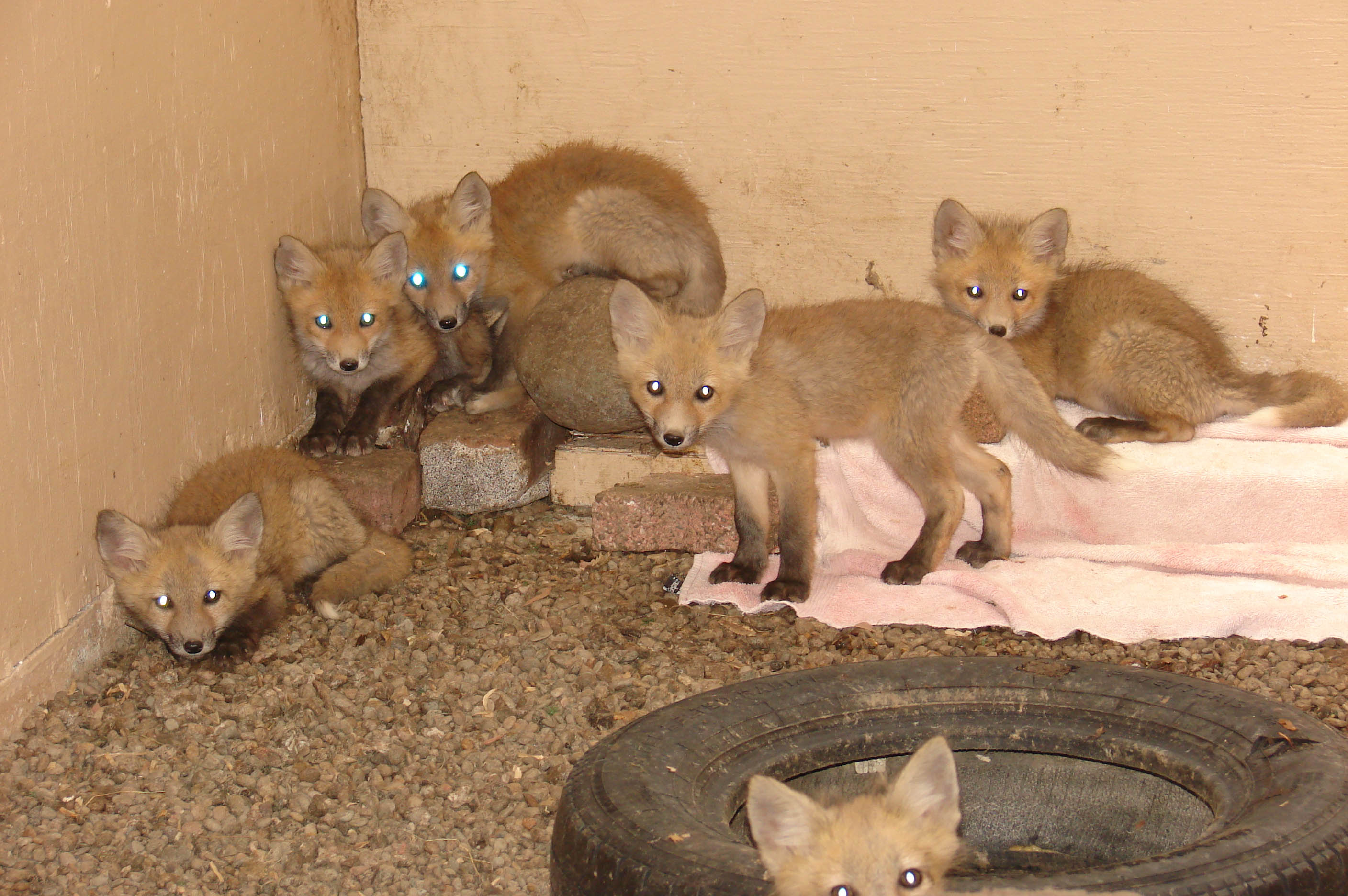
- Nine fox kits orphaned by USDA’s Wildlife Services | Photo
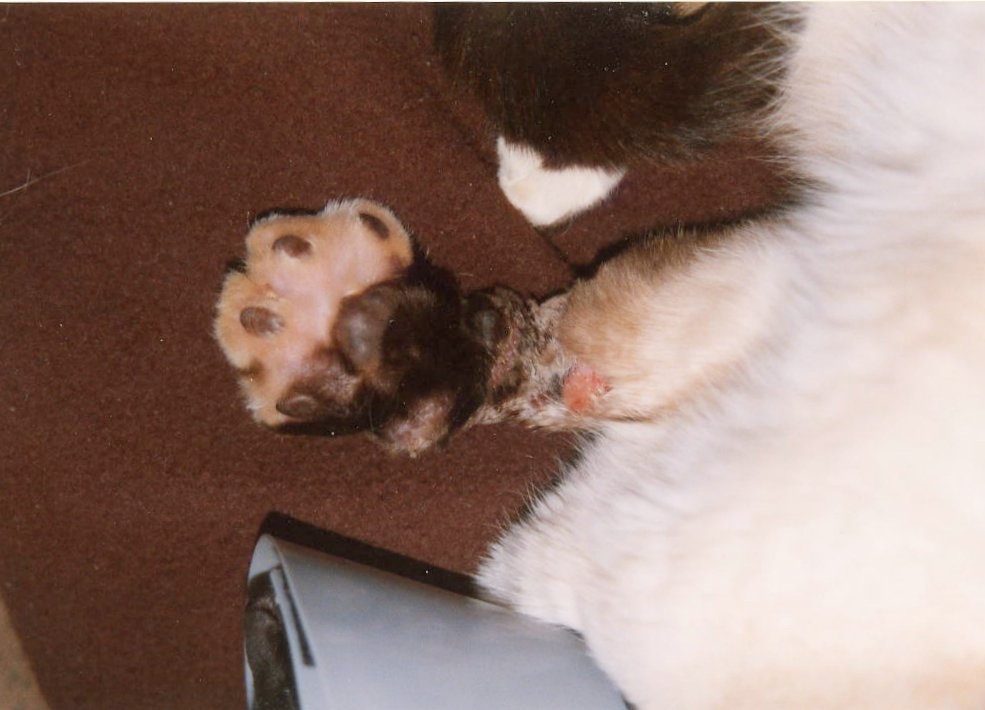
- Domestic cat injured in leg hold trap set by Wildlife Services. Leg was later amputated.
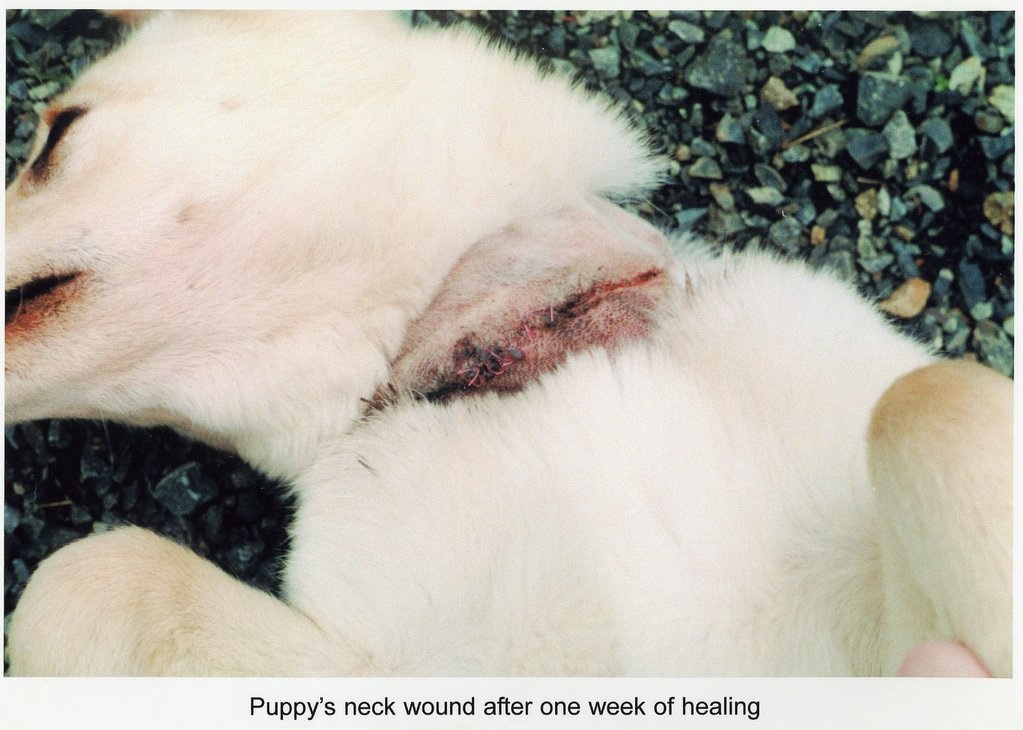
- Young puppy suffers after being caught in Wildlife Services’ necksnare. The puppy was discovered by area residents and the photo was taken after one week of healing.
- Coyote caught in Wildlife Services necksnare
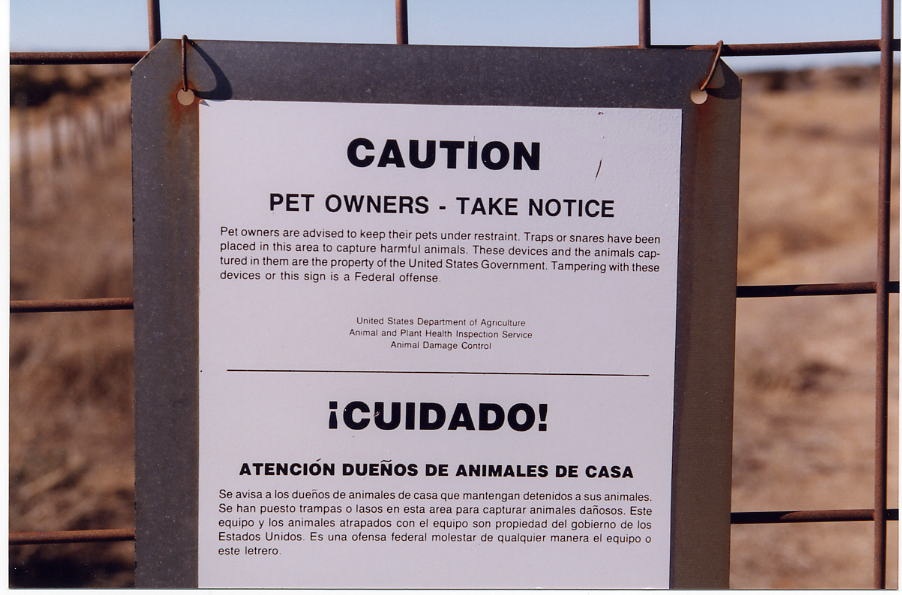
- Warning signs required to be posted by Wildlife Services. Often the signs are not posted or are missing.
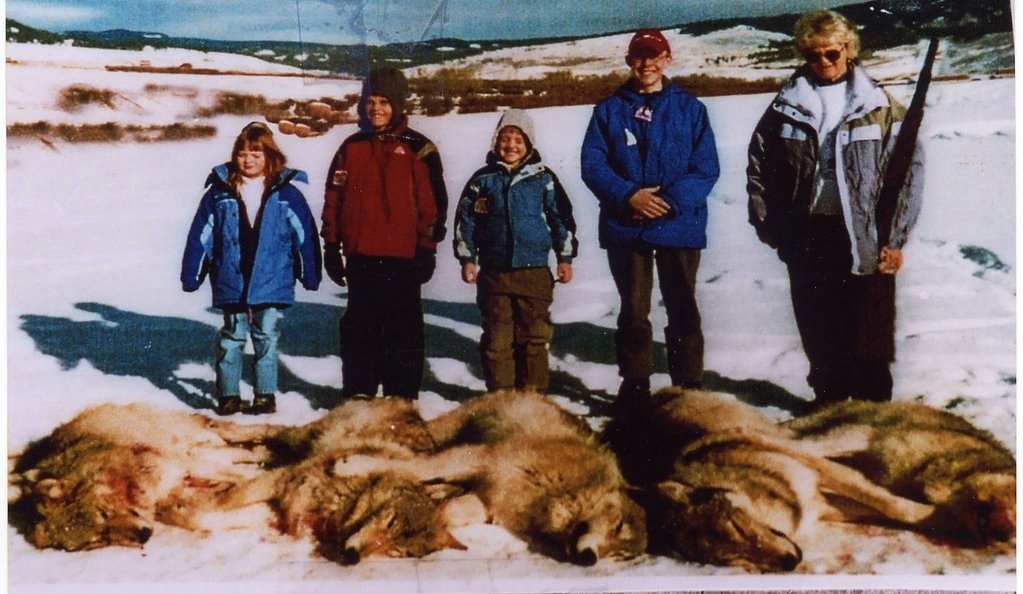
- School children in Montana pose with wolves that Wildlife Services killed with aerial gunning in 2004. Seven wolves were killed in this incident.
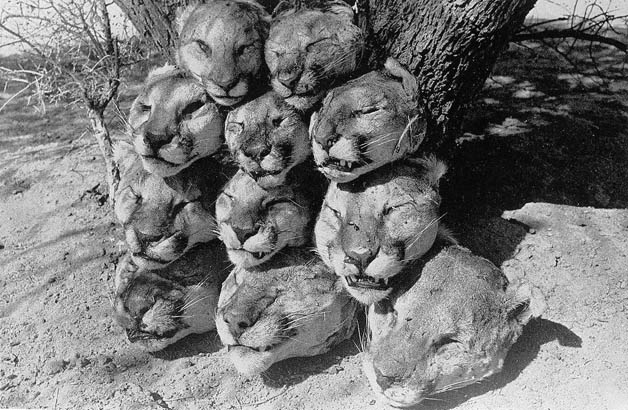
- Cougars killed by Wildlife Services. This infamous photo of the severed heads of 11 mountain lions was taken by an outraged employee of the Arizona Game and Fish Department. These animals were among 24 lions killed by the federal agency Animal Damage Control (now called Wildlife Services) in the Galiuro mountains of Arizona, a wilderness area North of Willcox. All were killed on federal lands on the Coronado National Forest over a six-month period from December 1988-May 1989. While it is uncertain whether any of these cougars ever preyed on livestock, the ostensible purpose of the killings was to protect cattle that were grazing on public lands. This type of indiscriminate lethal predator control continues in almost all of the states where mountain lions occur. California is an exception in that only specific mountain lions documented to have killed livestock or threatened people are subject to lethal control by wildlife agencies. Also, in California no sport hunting of mountain lions is allowed.
- “A Long Wait in a Trap”
- “Did Princess Have to Die?”
- “Wildlife Services’ Scare Tactics in Urban and Suburban Portland
Current data on animals killed by USDA Wildlife Services is available on their website. Their presentation is not user-friendly, which is telling.
Below are PDFs of their recent kill reports by category:
 Preservation of America's Wildlife