Research and Written by John Cox, Cascade Mountains
“Any fool can know. The point is to understand.” ― Albert Einstein
As Wild Horse Advocates, can any of us claim to not share this concern? By choice and by what we place emphasis upon, are we not environmentalists as well? We are! Unfortunately, societal awareness is grossly influenced by emotionalism and the misrepresentations (false narratives) often made by various special interest groups, to include some animal welfare groups as well. This has resulted in environmental concerns and advocacies which are highly diverse among individuals and groups.
The actions of extremists and the association of environmentalism with extremists’ viewpoints have caused some to not claim membership in the environmentalism movement. Although many of us do claim the situation of “Oneness – Wildlife, People, and our Environment as One Entity – or all is connected” as a Universal Truth toward cohabitation, the stigma remains. But some people reject the situation, as the introduction of such environmental hazards as Pesticide PZP and the future Pesticide GONACON, or cattle enhancing steroids, and other chemicals of a hazardous or highly toxic nature into our natural environment – which wreaks havoc with many ecological systems and the wildlife contained within them. The Wild Horses now a good example of this. . . and have been for decades now.
The roots of modern environmentalism can be traced to George Perkins Marsh and his book Man and Nature, first published in 1864, which provided extensive documentation that man was in the process of making global and often permanent changes in the “balance of nature” (Ehrenfield 1970, Stegner 1990).
Marsh described the effects of mass deforestation on the land, streams, wildlife and fish, and was responsible for establishing the broad features of the natural resources conservation ideology. He wrote of two ways to restore a natural “harmony”: protection alone and protection plus additional planned interference with biological and non-biological parts of the ecosystem to achieve a desired result. – (authors note) Currently, the desired result is to enhance nature and our environment, and all things inclusive – neglect none!
It was not until 1933, when Aldo Leopold published Game Management, that an approach became practical. This was the beginning of modern wildlife management as practiced today. Whether or not Aldo Leopold ideologies have indeed been followed through, within every aspect of its primary structured plans, currently remains debatable; but the basis is sound and workable if done so correctly.
Recent opinion surveys indicate that a majority of Americans believe that the poor quality of the environment is one of our most serious national problems, more than homelessness and unemployment. If the environment protected, American’s favor among other things, limiting economic development, change our consumptive habits, decreasing government regulations and leave natural Ecosystems natural. Taxpayers make it clear, and say they will support politicians who support such these types of measures (Gilbert 1990). “Quality of life” has become a major concern to many, and the quality of life of our natural environment and wild life as well, and to many Americans’.
One inherent problem is the majority of the American public realizes that government agency policy-makers and some research biologists – do assume many American’s ignorant about wildlife, and some even state within a condescending manner, that many people think that virtually every wildlife species is on the brink of extinction. These are the type of policy-makers and biologists that American’s do not need. American’s tend to be more educated, and stand-firm on realistic observation and experience more so than academic-snobs can understand – We know and acknowledge there does exist, within a reality complex, that many animals are on the verge of extinction and government agencies do not want to do anything about the situation — unless forced to do so. Yes, government and their support minions, and commercialized non-profits, do more to promote their budgets and donation streams, than actually working on “Saving” much of anything – horses and wildlife inclusive.
Though government agency reasoning untrue, it is still a resource management ideology none the less, as we see in many future plans for our Public Lands. In reality, there is a growing aversion to wildlife management activities that involve the killing of wildlife. It is becoming deeply rooted within American’s minds, especially taxpayers that pay for the continual environmental mess government agencies profoundly continue to awkwardly at best, develop. And on it goes, their attempts to fix the previous mess they made from that previous mess, and from the entire mess before that — and oh yes, the lies to duck-and-cover public scrutiny, profoundly-abundant and costly to taxpayers, as well.
Conclusively — The future of wildlife management is in our hands, the American people. It is shown time and again that government agencies simply do not have the proper management potential to manage our public lands appropriately. What are we—you and I—going to do?
Environmental concerns and the resultant demands and restrictions on wildlife management and ideologies, and the many activities, will certainly increase. The animal welfare issue will grow larger, thankfully. Open Debate Platforms more assuredly resolve problems, compared to the behind-the-closed-door paradigms that exist today.
Wildlife management actions will increasingly be influenced by American taxpayers, Environmentalists, and some Wildlife Advocates – Commercialized non-profits not so mush. Biological rational will prevail if only we, American’s, take charge and become involved – especially within land planning and wildlife decision making.
Whether it does or not will depend on how effective we are at reasoning and at the same time demand proper wildlife management. We must continue to be proactive in our concerns for the environment and animal welfare together. Government agencies must understand that management decisions are predicated on these concerns.
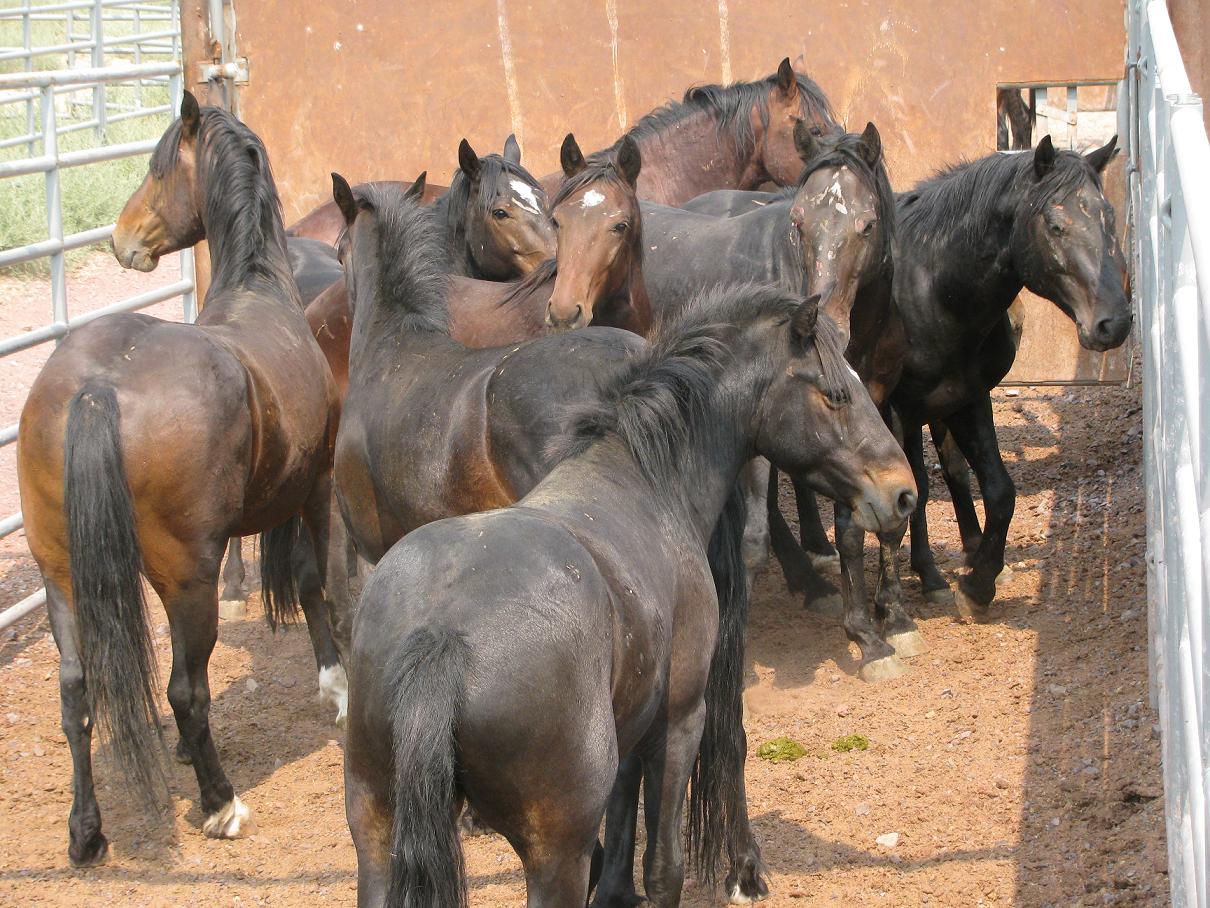
(Note) In the photo are Murder Creek Wild Horses, supposedly Bait and Trapped (BLM states a safe way to roundup Wild Horses) and yet, see the photo = Truth!
________________________
References and Material Perused
Ehrenfield, D. W. 1970. Biological conservation. Holt, Rhinehart and Winston, Inc., New York. 226pp.
Gilbert, B. 1990. Earth day plus 20, and counting. Smithsonian 21. 8pp.
Gilbert, F. F., and D. G. Dodds. 1987. The philosophy and practice of wildlife management. Krieger Publ., Malabar, Fla. 279pp.
Goldfarb, T. D. 1983. Taking sides: clashing views on controversial environmental issues. Dushkin Publ., Guilford, Conn. 311pp.
Mish, F. C, chief ed. 1986. Webster’s ninth collegiate dictionary. Merriam-Webster Inc., Springfield, Mass. 1563pp.
Odell, R. 1980. Environmental awakening. Ballinger, Cambridge, Mass. 330pp.
Reich, C. A. 1970. The greening of America. Random House, New York. 399pp.
Schmidt, R. H. 1989. Animal welfare and wildlife management. Trans. North Amer. Wildl. and Natur. Resour. Conf. 54:468-475.
_______. 1990. Why do we debate animal rights? Wildl. Soc. Bull. 18:459-461. Stegner, W. 1990. It all began with conservation. Smithsonian 21. 9pp
 Preservation of America's Wildlife