Category: Uncategorized

  • Wild Horse’s and Re-Establishing into Wilderness Areas to Save Both

    From tiny viruses and bacteria, unrecognized for millennia, to blue whales weighing 200 tons, and fungi that spread for hundreds of hectares underground, the diversity and extent of life on Earth is dazzling.  In its life and reproduction, every organism is shaped by, and in turn shapes, its environment.  It is this inter-action of a healthy Ecological Habitat, not human-species management of either, that will, indeed, save the Wild Horses and our overall environmental complex.

    We find that animals fill “niches” or a role within a habitat or ecosystem.  This is how a diversity of members of species participate in the distribution of resources, that includes such features as time of day they are active, the plants they exploit, how they vie for competitors, et al. What is found most often, is these niches are filled with one species, a specialist, so to speak.

    A good example here would be if two species compete at the same time for the same fruit, one species has, most often, a slight advantage over the other – sometimes a bit earlier out of the nest in the morning or a bit quicker to detect danger.  Eventually this advantage will result in the more competitive species displacing its rival completely.  But adaptation takes place, most often, and the subordinate species develops behaviors to fill a different niche, or it may die. . .

    When we speak about Wild Horses, we find they fill specific “niches” within a diverse habitat, that when all is assumed, they also show us, among other species, credibility within an Ecosystem, or just how healthy the habitat has become, or not.  Because the Wild Horse is a browser, an ecological diversity of wildlife, inclusive of predators, keeps them as well as other browsers on the move, as their survival instinct kicks into play.

    This is a brief summary, but what transpires remains a positive circumstance, as good science shows us overwhelmingly.  A diversity within a healthy habitat – inclusive of marine, terrestrial, and wildlife, and many niches available with many of the wildlife filling those niches – competitive and non-competitive.  niches are defined by the species that fill them.  This means that their way of life, habits, and food preferences will not overlap, completely.  And as science shows us, once again, by remaining in an ecological niche to which they are well adapted, species make room for one another.

    This is significant to remember, when someone speaks, opinion-only and no science to back it up, that predators control the ecology – this is an untruth – as diversity always needed for a healthy ecology.  To fulfill a niche in nature is to develop a primary strategy for survival.  Human’s are the only species that kills for sport, or whatever excuse they develop.  When wildlife lives within a healthy process, or a natural system, or an Ecological Habitat, they adapt and make room for one another, such as pieces of a jig-saw puzzle fit together, all for survival . . .

    Keystone Species

    “A “keystone” is the top stone in an arch, and both sides of the arch lean on it.  Remove the “keystone” and the arch collapses.  Remove a “keystone” species, and an ecosystem may well collapse.”  — E.O. Wilson, PhD Research Biologist

    We see examples of this situation throughout the United States (e.g. Otters and sea urchins, wolves, cougars, shark et al), but the more prominent example were the studies by Aldo Leopold, and removal of the wolf.  Eventually, lesson learned, Leopold understood wiping out the wolves to be a “negative” extreme, as the niche they filled left vacant, and browsers took over the parklands, and the ecosystem decimated, barren landscape developed, wildlife starved, trees and shrubs destroyed, and both marine and all other terrestrial lands destroyed.  Yellowstone Park is a good example, as well, and until the wolves re-established, Yellowstone almost destroyed in total.

    Ecological release of a species shifts an ecosystem to a new equilibrium, essentially radically transforms it.  Often it is a short-term event, such as over-hunting by human-species and improper wildlife management (such as the broken wildlife management systems of today in the United States), or establishing a single-species priority of cattle, a non-indigenous species, and forcing a natural habitat, or ecological system to adjust to the species – backed by no affirmative science, destruction follows.  Competition is required in nature, which establishes healthy ecology — when removed, we have what is termed Ecological Displacement, which can lead to “Extinction” – and debatable whether positive or negative, it can also lead to behavioral and even evolutionary adaptations’.

    Interactions in Ecosystems

    “Food chains and food webs” shape the flow of energy and material through ecosystems; predation and competition define niches.”

    We find “symbiosis” the central definable circumstance of this interaction and species contribution within ecosystems.  Interesting that in Greek symbiosis means “living together”, and essentially a close and consistent interaction between two species, whereas, both obtain benefit.

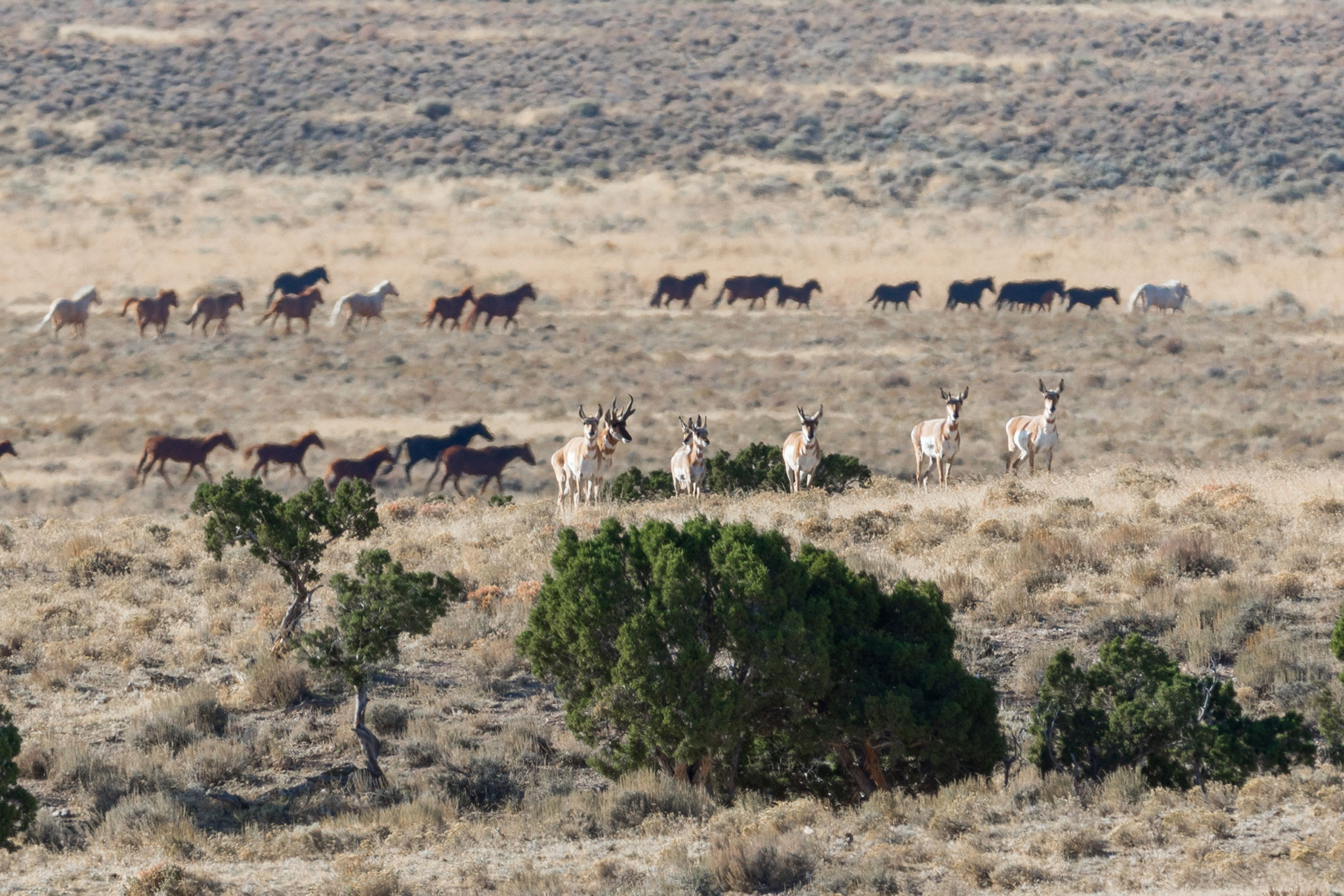
    The symbiotic reaction of Wild Horse Bands, for example, “commensalism”, where a small horse band shares their grazing-ground with birds.  The bands, the horse hooves, stir up insects within the grasses, which the birds at times will circle, or dive, or sit upon the horses’ back waiting, then dive down and snap-up the insects.  Of course, attracting some of the birds who may carry seeds very beneficial to the habitat overall, the grasslands remain healthy, and the re-seeding establishes growth . . .

    We can now start to see how the government agencies, the Bureau of Land Management, the USDA Wildlife Services, and the USDA Forestry, are site specific and their approach toward our living Ecological Systems are simply destructive in total; nor, backed by any research or data gathering.  Their perspective remains bias, bigoted, and even ignorant, within the aspect of a Single-Species priority of cattle, where no natural reaction can occur for the betterment of nature, as they insist upon wiping-out, or sacrificing, all other wildlife, for cattle-only — which in turn destroys the overall Environmental complex.  These government agencies then act as though their styled-ignorance remains superior, but in reality, is of no science, and something not acceptable –never has been and never will be within nature.

    Conclusively, I will leave you with the short-summary below, of how “one-tree” can serve, within a healthy Ecology, many different types of niche specialists, wildlife at its best, and how they operate in a natural environment.  A good example of Nature’s Diversity and how a niche within a habitat works positively, for the betterment of the overall Environment – something to keep in mind:

    “MacArthur’s Warblers”

    Five species of insectivorous wood warblers — Cape May, Yellow-rumped, Black-throated Green, Blackburnian, and Bay-breasted — were the subject of a classic study of community ecology (the science of interpreting species interactions). These species often share the same breeding grounds in mature coniferous forests.

    They had been thought by some ornithologists to occupy the same niche — in other words, they appeared to assume identical roles in the same bird community. These five warblers would thus be an exception to the ecological rule of competitive exclusion. The rule states that two species with essentially the same niche cannot coexist because one will always out-compete and displace the other.
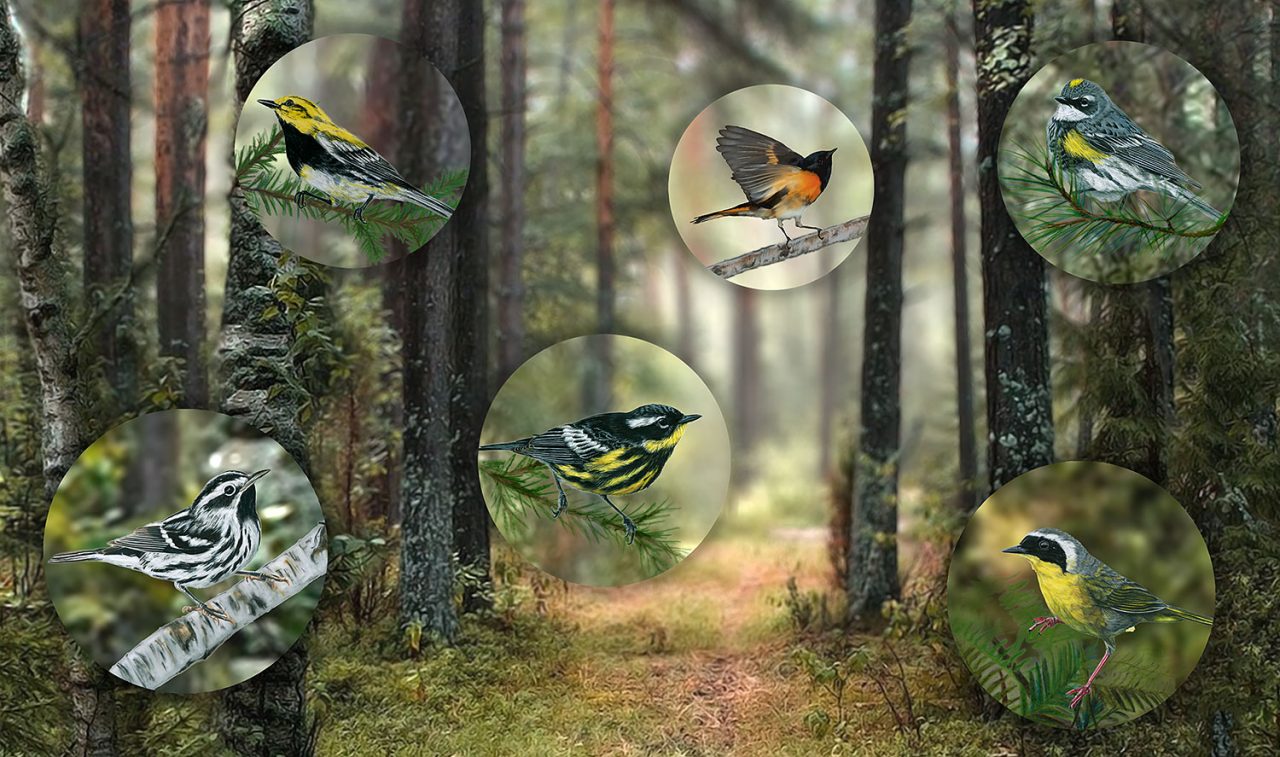
    For his doctoral dissertation, the late Robert MacArthur, who became one of the nation’s leading ecologists, set out to determine whether the five species of warblers actually did occupy the same niche. By measuring distances down from the top and outward from the trunk of individual spruce, fir, and pine trees, MacArthur divided the trees into zones and recorded feeding positions of the different warblers within each.

    A record in zone “T3” indicated a bird feeding among the abundant new needles and buds of the tip of a branch, between 20 and 30 feet from the top of the tree. A record of “M3” signified feeding mostly among dead needles at the same height but in the middle zone of a branch. A record of “B2” represented a warbler feeding on the bare, lichen-covered base of a branch. In all, 16 different positions were distinguished,

    “MacArthur found that each warbler species divided its time differently among various parts of the tree. The Cape May, for instance, stayed mostly toward the outside on the top, the Bay-breasted fed mostly around the middle interior, while the Yellow-rumped moved from part to part more than either of the other two. This is shown in the accompanying diagrams, in which the zones that contained 50 percent of the birds’ feeding activity are blackened.MacArthur also recorded details of the warblers’ foraging habits and discovered that they differed too. For example, the Cape May warbler hawks flying insects much more often than does the Blackburnian and tends to move vertically rather than horizontally (matching its tendency to remain on the outside of the tree). The Black-throated Green hovers much more than the Bay-breasted, and the more variable Yellow-rumped has the most varied feeding habits. In addition, MacArthur found evidence that food shortage limited the size of the warbler populations.

    Overall, MacArthur concluded that “the birds behave in such a way as to be exposed to different kinds of food.” They also have somewhat different nesting times, and thus the times of their peak food requirements are not the same. They are partitioning a limiting resource — their supply of insects, and, in the process, occupying different niches.”

    Research and Written by — John Cox, Cascades

    References:

    Beerling, D. The Emerald Planet: How Plants Changed Earth’s History. Oxford, UK: Oxford University Press, 2007.

    Biro, P. A., Beckmann, C. et al. Small within-day increases in temperature affects boldness and alters personality in coral reef fish. Proceedings of the Royal Society B: Biological Sciences 277, 71-77 (2010).

    Burger, W. C. Flowers: How They Changed the World. Amherst, NY: Prometheus Books, 2006.

    Chapin, F. S., Matson, P. A. et al. Principles of Terrestrial Ecosystem Ecology. New York, NY: Springer Science+Business Media Inc., 2002.

    Chapin, F. S., Vitousek, P. M. et al. The nature of nutrient limitation in plant communities. The American Naturalist 127, 48 (1986).

    Cowen, R. History of Life. Boston, MA: Blackwell Scientific Publications, 1990.

    Dethlefsen, L., Huse, S. et al. The pervasive effects of an antibiotic on the human gut microbiota, as revealed by deep 16S rRNA sequencing. PLoS Biology 6, e280 (2008).

    Gaston, K. J. Global patterns in biodiversity. Nature 405, 220-227 (2000).

    Hata, H., Watanabe, K. et al. Geographic variation in the damselfish-red alga cultivation mutualism in the Indo-West Pacific. BMC Evolutionary Biology 10, 185 (2010).

    Kaspari, M. (2008), Knowing Your Warblers: Thoughts on the 50th Anniversary of Macarthur (1958). The Bulletin of the Ecological Society of America, 89: 448–458. doi:10.1890/0012-9623(2008)89[448:KYWTOT]2.0.CO;2

    Kleidon, A., Fraedrich, K. et al. A green planet versus a desert world: estimating the maximum effect of vegetation on the land surface climage. Climatic Change 44, 471-493 (2000).

    Marquez, L. M., Redman, R. S. et al. A virus in a fungus in a plant: three-way symbiosis required for thermal tolerance. Science 315, 513-515 (2007).

    May, R. M. How many species are there on Earth? Science 241, 1441-1449 (1988).

    MacArthur, RH. (October 1958) Population Ecology of Some Warblers of Northeastern Coniferous Forests. Ecology, 39(4), 599-619.

    Morton, O. Eating the Sun: How Plants Power the Planet. New York, NY: HarperCollins, 2008.

    Parker, A. R. & Lawrence, C. R. Water capture by a desert beetle. Nature 414, 33-34 (2001).

    Pringle, R. M., Doak, D. F. et al. Spatial pattern enhances ecosystem functioning in an African savanna. PLoS Biol 8, e1000377 (2010).

    Riedman, M. Sea Otters. Monterey, CA: Monterey Bay Aquarium Press, 1990.

    Riedman, M. The Pinnipeds: Seals, Sea Lions, and Walruses. Berkeley, CA: University of California Press, 1991.

    Schlesinger, W. H. An analysis of global change. In Biogeochemistry. 2nd ed. (New York: Academic Press, 1997).

    World Health Organization. Millennium Ecosystem Assessment: Ecosystems and Human Well-being: General Synthesis. Washington, DC: Island Press, 2005.

  • Wild Horses Back to Our Lands in America — ReEstablish / ReWild — No Human Encumbrance

    Let’s discuss more about the science and intricacy, of placing wild horses back onto our Public and Federal Lands – and at the same time increase our wildlife habitats, increase the quality of ecological habitats and Ecology Islands, increase the quality of Our Nation’s water supply, increase Our Nations grasslands (only a mere 18% left of the very basic Grains and other vegetation that was the foundation of America’s food-chain for two-Plus-Centuries), rid Our public and federal lands of pollutants, radioactivity in the soil and beef/sheep meat supply, as well as other dangerous chemicals from the current industrial boom now ongoing on Our lands, and all around increase Our Nations Environmental Complex. . . for the better.

    Population Density

    Science begins with very basic principles, and in this case Population Density is nothing more than a Space-Available context and to obtain good results, or improvements to our Public and Federal Lands.  Quite frankly, none of the important situations within the context of placing wild horses back onto Our Public and Federal Lands (and leave the wild horses’ already there, on the range) does not include any drama what so ever. . .

    Often drama is imposed by those who are supportive of such situations as BLM lies and misinformation (for example, we see advocates sharing office space with BLM, their mission too merely start problems within advocacy, if allowed), or monetary situations, and support BLM / Forestry, pesticides and other birth control situations, and experiments upon our wild horses – money involved in all of the drama opposing the placement of wild horses back onto Our Nation’s Lands – FACT and insurmountable evidence to show this in total, as a specific truth.

    “The federal government owns about 640 million acres of land in the United States, about 28% of the total land area of 2.27 billion acres. The majority of federal lands (610.1 million acres in 2015) are administered by the Bureau of Land Management (BLM), U.S. Fish and Wildlife Service (FWS), National Park Service (NPS), or U.S. Forest Service (FS). BLM, FWS, and NPS are part of the U.S. Department of the Interior, while the Forest Service is part of the U.S. Department of Agriculture. An additional 11.4 million acres of land (about 2% of all federal land) is owned by the U.S. Department of Defense (DOD). The majority of federal lands are located in Alaska and the Western states.” – See references section

    There exists more than enough room, upon the Multi-Purpose Lands we, as taxpayer’s own, ultimately.  We can essentially move on to environmental conditions.  Density Factors, independent from normal environmental factors, yet directly affect population density, which are situational, floods, droughts, volcanic habitats, and any other cataphoric-situation that has the potential of short-term or long-term effects upon populations such as wild horses, the wolves, cougars, or mid-range wildlife as well . . .

    Population Cycles

    Within any Ecological Habitat, it is the environmental factor that constrain the population, in combination with the density-independent factor; which, interesting enough, sets an upper limit on population size.  These components also all inclusive of why so many advocates are against the wreckless Human-Infringement and the use of breed controls upon wildlife, as nature takes care of the situation quite well enough, and infringement, truthfully, unneeded – i.e. birth controls and roundups.

    The human-problem is simply of erroneous perception of nature, if admitted or not, as well as bias, ignorance, and an odd realm of bigotry, and of nothing more than, they are right and everyone else wrong.  No one ever admits they are a bigot; and thereby, the human problem increases exponentially over time . . . We endeavor to neutralize this type of human-problem, through quality management, and decision-making mandatory upon science, good data, and rendering of quality hypothesis.

    Keep in mind, as science shows us consistently, it is the population-size that also effects the rate of growth of the population, and by the addition or removal of density-dependent factors.  We can use science here, and deduct a sincere and reasonable abstract of knowledge; whereas, one species can be defined within several segments of population density, and within area proximity.

    As Wild Horse Advocates, we simply need to stop acting like a cluster of wild coyotes after the same piece of road-kill, and start organizing to get the Wild Horses; ether to,

    1. “Remain” on Our Lands in America, and “Place-Back” Our Wild Horses, onto Our Lands, and manage them properly under scientific reasoning; and

    2. Refrain from the twisted and disenfranchised term of Humane and the use of breed controls, roundups, or slaughter mind-sets, that are nothing more than ignorance and simply do not work at all, within any “Humane” perspective.

    A wild horse band, for example, can survive quite well in the eastern areas of Washington State, or in Central or Eastern Oregon as well, and the population, as long as it is left alone separated from human-problems and egos, and as long as diversity of wildlife combined with a terrestrial diversity of shrubs, grasses, et al., and within a healthy Ecology, then moderation of population takes place within a natural occurrence – Population Density situations take hold as well.

    Cross-species factors are involved also.  This is where the addition of removal or addition of population-density factors can transform an ecological system that can, and as science shows us quite well, does in many ecology islands, and establishes a new equilibrium factor.

    Now, with this said, and clear in our minds, we then take this a step further.  Every species has critical density-dependent factors, wild horses are not exempt.  Again, as science shows us, if one of these factors removed – through environmental change, for example, or even experimental manipulations, or breed controls, etc., the population begins to grow until a new density-dependent factor kicks-in.

    And yes, due to the reality of scientific research, we find that the BLM / Forestry interference with the wild horses (coyotes experience this same shift in population densities, when interruption exist in populations, the populations simply increase, naturally) seem to be more of a manipulation, or an ignorantly based situation for promotion of problems that simply do not exist, or job security for a large government agency, to keep doing things that prohibit “Moderation” of wild horse populations, and increase population.

    We can truthfully state, scientifically and beyond all doubt, the things that the Bureau of Land Management does do, within their wild horse management paradigms, as well as the USDA Forestry, and due to their lack of knowledgeable science as well as lack of biological knowledge, moderation of the wild horses on Our Federal Lands simply “cannot exist” – then add the breed control paradigms, and it increases, again, exponentially – the wild horses simply have no chance, and extinction eminent.

    Conclusion

    The re-establishment of wild horses, as well as other wildlife, within Washington, Oregon, Idaho, California and other Western 11 States, becomes a point of wildlife and terrestrial Diversity.  Within this diversity we can use the data and survivorship curves, in research, to track trends and to understand the dynamics of a given population.

    This is far superior to what we have now, the Single-Species Paradigm = Cattle, which is merely guess-work, and a proven very arrogant/ignorant methodology of Public and Federal Lands management – as we see in several very destructive situations now existing on Our Lands in America.  We also see a time when the Beef and Sheep meat products will be too polluted for Public Consumption, and it is not that far off.  Once again, it is science that shows us this quite clearly now.  The industrialized Multi-Purpose Lands Management theories, unproven by quality-science as well, simply is not working, and is very destructive to our lands.

    Once again, we also get into the Strategic elements of re-establishing species upon Our Lands, in America, within a positive framework, and observation playing a major roll in data gathering and regulatory compliance – compared to the willy-nilly situation of No-Compliance on our lands in America, currently.

    Big problem, as pointed out above . . . Corruption, irresponsible conduct by government employees, as well as bad nonscientific management paradigms, based on special interests only, and America, we have a problem – But yes America, we have an answer to the problems up and coming, make no doubt.

    Research and Written by — John Cox, Cascades

    REFERENCES

    Paul Rodgers, United States Constitutional Law: An Introduction (2011), p. 100-101.

    Gibson v. Chouteau, 80 U.S. 92, 99 (1872), U.S. v. Grimaud, 220 U.S. 506 (1911), Light v. U.S. 220 U.S. 523 (1911), Utah Power & Light Co. v. U.S., 243 U.S. 389, 405 (1917), Ashwander v. Tennessee Valley Authority, 297 U.S. 288, 336 (1936).

    Lipton, Eric, and Clifford Krauss, Giving Reins to the States Over Drilling, New York Times, August 24, 2012.

    Carol Hardy Vincent, Carla N. Argueta, & Laura A. Hanson, Federal Land Ownership: Overview and Data, Congress Research Service (March 3, 2017).

    Kleppe v. New Mexico, 426 U.S. 529 (1976).

    Tom Fredericks & Andrea Aseff, When Did Congress Deem Indian Lands Public Lands?: The Problem of BLM Exercising Oil and Gas Regulatory Jurisdiction, 33 Energy Law Journal 119 (2012).

    “Trust Land” in Treaties with American Indians: An Encyclopedia of Rights, Conflicts, and Sovereignty (ed. Donald L. Fixico: ABC-CLIO, 2008), p. 956.

    Allen, L. , Engeman, R. , and Krupa, H. (1996). Evaluation of three relative abundance indices for assessing dingo populations. Wildlife Research 23, 197–206.

    Bayne, P. , Harden, B. , Pines, K. , and Taylor, U. (2000). Controlling feral goats by shooting from a helicopter with and without the assistance of ground-based spotters. Wildlife Research 27, 517–523.

    Boonstra, R. , Krebs, C. J. , Boutin, S. , and Eade, J. M. (1994). Finding mammals using far-infrared thermal imaging. Journal of Mammalogy 75, 1063–1068.

    Bull, E. L. , Holthausen, R. S. , and Bright, L. R. (1992). Comparison of 3 techniques to monitor marten. Wildlife Society Bulletin 20, 406–410.

    Caley, P. A. , and Morley, C. G. (2002). Assessing growth rates of European rabbit populations using spotlight transect counts. Journal of Wildlife Management 66, 131–137.

    Caughley G. (1977). ‘Analysis of Vertebrate Populations.’ (John Wiley and Sons: New York.)

    Davis D. E. (1982). ‘CRC Handbook of Census Methods for Terrestrial Vertebrates.’ (CRC Press Inc.: Boca Raton, FL.)

    Dodd, M. G. , and Murphy, T. M. (1995). Accuracy and precision of techniques for counting great blue heron nests. Journal of Wildlife Management 59, 667–673.

    Edwards, G. P. , dePreu, N. D. , Shakeshaft, B. J. , and Crealy, I. V. (2000). An evaluation of two methods of assessing feral cat and dingo abundance in central Australia. Wildlife Research 27, 143–149.

    Elbert, J. E. , Kost, C. D. , Rasmussen, R. L. , Johnson, D. L. , and Jenks, J. A. (1999). Lipophilic MRI contrast agents as potential markers for carnivore population studies. Proceedings of the South Dakota Academy of Sciences 78, 109–114.

    Engeman, R. M. , and Allen, L. (2000). Overview of a passive tracking index for monitoring wild canids and associated species. Integrated Pest Management Reviews 5, 197–203.

    Engeman R. M., and Witmer G. W. (2000). IPM strategies: indexing difficult to monitor populations of pest species. In ‘Proceedings of the 19th Vertebrate Pest Conference’. (Eds T. P. Salmon and A. C. Crabb.) pp. 183–189. (University of California: Davis, CA.)

    Foran, D. R. , Minta, S. C. , and Heinemeyer, K. S. (1997). DNA-based analysis of hair to identify species and individuals for population research and monitoring. Wildlife Society Bulletin 25, 84–0847.

    Glen, A. S. , and Dickman, C. R. (2003). Monitoring bait removal in vertebrate pest control: a comparison using track identification and remote photography. Wildlife Research 30, 29–33.

    Lancia R. A., Nichols J. D., and Pollock K. H. (1994). Estimating the number of animals in wildlife populations. In ‘Research and Management Techniques for Wildlife and Habitats’. (Ed. T. A. Bookhout.) pp. 215–253. (The Wildlife Society: Bethesda, MD.)

    Litvaitis, M. K. , and Litvaitis, J. A. (1996). Using mitochondrial DNA to inventory the distribution of remnant populations of New England cottontails. Wildlife Society Bulletin 24, 725–730

    Poole, D. W. , Cowan, D. P. , and Smith, G. C. (2003). Developing a census method based on sight counts to estimate rabbit numbers. Wildlife Research 30, 487–493.

    Quy, R. J. , Cowan, D. P. , and Swinney, T. (1993). Tracking as an activity index to measure gross changes in Norway rat populations. Wildlife Society Bulletin 21, 122–127.

    Schneider B. A. (1982). ‘Pesticide Assessment Guidelines.’ (US Environmental Protection Agency: Washington, DC.)

    Schwartz, C. J. , and Seber, G. A. F. (1999). Estimating animal abundance: review III. Statistical Science 14, 427–456.

    Seber G. A. F. (1982). ‘The Estimation of Animal Abundance.’ 2nd edn. (MacMillan Publishing Company Inc.: New York.)

    Seber, G. A. F. (1986). A review of estimating animal abundance. Biometrics 42, 267–292.

    Seber, G. A. F. (1992). A review of estimating animal abundance. II. International Statistical Review – Revue Internationale de Statistique 60, 129–166.

    Thompson, J. A. , and Fleming, P. J. (1994). Evaluation of the efficacy of 1080 poisoning of red foxes using visitation to non-toxic baits as an index of fox abundance. Wildlife Research 21, 27–39.

    Thompson W. L., White G. C., and Gowan C. (1998). ‘Monitoring Vertebrate Populations.’ (Academic Press Inc.: New York.)

    Tracey, J. P. , Fleming, P. J. , and Melville, G. J. (2005). Does variable probability of detection compromise the use of indices in aerial surveys of medium-sized mammals? Wildlife Research 32, 245–252.