Kathleen Gregg, Environmental Researcher and
Michele Anderson, Environmental Researcher
“BLM states biologically impossible annual
wild horse population rates…”
Photo by Jesica Johnston
The Bureau of Land Management (BLM) recently posted their annual Wild Horse and Burro Herd Statistics. As in previous years, BLM’s report is full of obviously false, biologically impossible population growth data.
WHY is it important to expose this fraud? Because BLM uses the phony figures to convince everyone (but especially, the Congress) that an overpopulation crisis exists. Given the “crisis,” BLM requests millions of dollars in funding to capture and remove thousands of wild horses and burros from the range or, alternatively, to sterilize them. The fraudulent figures reflect BLM’s corruption. Yet, the Agency is granted deference, as if it were providing true data.
BLM’s falsified population figures affect not only specific herds (by triggering unwarranted, excessive roundups) but also misrepresent the total wild horse and burro population. The astronomically high numbers for certain herds significantly inflate the summary data, making it seem as if all herds grow at a high rate.
Here are just a few of the many false figures that BLM is alleging for the reporting-year beginning March 1st, 2022, and ending February 29th, 2023:
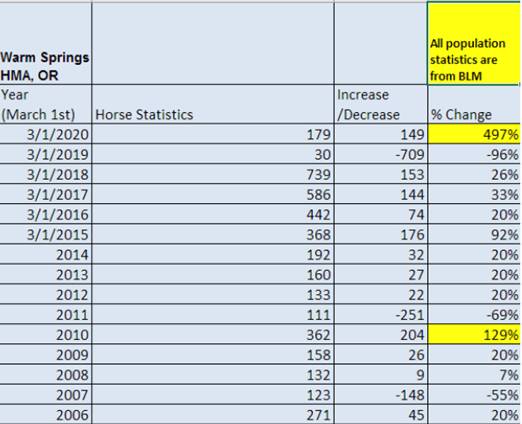
WARM SPRINGS Herd Management Area (HMA) a 497% increase in ONE year (per BLM, a herd of 30 horses produced 149 successful foals in one year which would require that every single horse – including the stallions! – have more than four surviving foals in one year. Biologically impossible
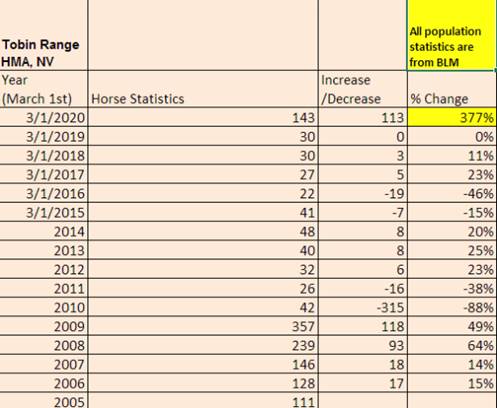
TOBIN RANGE Herd Management Area (HMA) a 377% increase in ONE year (pe BLM a herd of 30 horses produced 113 successful foals in one year which would require that every single horse – including the stallions! – have more than three surviving foals in one year. Biologically impossible
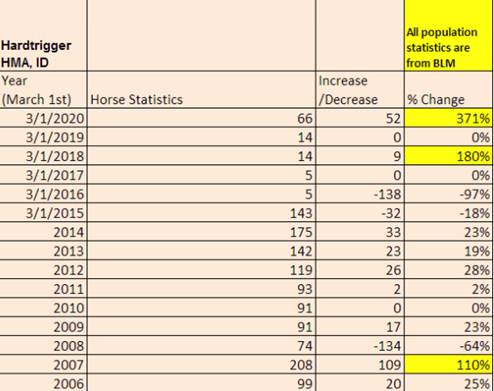
HARDTRIGGER Herd Management Area (HMA) a 371% increase in ONE year (per BLM a herd of 14 horses produced 52 successful foals in one year which would require that every single horse – including the stallions! – have more than three surviving foals in one year. Biologically impossible
SNOWSTORM Mts. Herd Management Area (HMA) a 252% increase in ONE year (per BLM a herd of 90 horses produced 227 successful foals in one year which would require that every single horse – including the stallions! – have more than two surviving foals in one year. Biologically impossible
DIAMOND HILLS SOUTH Herd Management Area (HMA) a 187% increase in ONE year (per BLM a herd of 216 horses produced 404 successful foals in one year which would require that every single horse – including the stallions! – have more than one surviving foal in one year. Biologically impossible
DIAMOND HILLS NORTH Herd Management Area (HMA) a 129% increase in ONE year (per BLM a herd of 271 horses produced 349 successful foals in one year which would require that every single horse – including the stallions! – have more than one surviving foal in one year. Biologically impossible
Not only are these false statements misleading to Congress and to the public but the perpetrators (BLM) of these fraudulent population increases are in violation of Title 18 (18 U.S.C. § 1001).Making false statements (18 U.S.C. § 1001) is the common name for the United States federal CRIME laid out in Section 1001 of Title 18 of the United States Code, which prohibits making false or fraudulent statements, in “any matter within the jurisdiction” of the federal government of the United States, 18 U.S. Code § 1519. Whoever, in any matter within the jurisdiction of the executive, legislative, or judicial branch of the Government of the United States, violates this federal crime shall be fined under this title, imprisoned not more than 5 years.
Horses and burros have an approximate 11-month gestation period but as shown above and in their statistics, BLM continually gives biologically impossible annual herd increases. A recent study of 5,859 wild horses showed that although the average annual birth rate was about 20%, the survival to the age of yearling was only half of those – therefore a maximum herd increase of only 10%. In addition, adult mortality must be factored which therefore reduces the average herd increase to less than 10% annually.
The National Academy of Science report cited two chief criticisms of the Wild Horse and Burro Program: unsubstantiated population estimates in herd management areas (HMA), and management decisions that are not based in science (NAS, 2013). The BLM’s biologically impossible and scientifically indefensible population-growth rates constitute dishonest and distorted data, which the BLM uses to mislead Congress and the American people
WHY is this so important? Because these are the statistics that BLM gives to Congress when requesting funding for wild horse and burro capture and management plans, including the recent BLM $1-Billion Wild Horse Disaster Plan that pushes for massive roundups and the destruction of wild horse social behaviors through surgical and chemical sterilization for both mares and stallions. . These false population statements are a federal crime punishable by prison and a fraudulent action against the American public in addition to being a travesty against our wild horses and burros.


