NOR STANDARDS WITHIN UTILITY FIELD TESTING
A White Paper – Brief
John W. Cox, M.A. C/M
“The Truth must dazzle gradually
Or every man be blind.” – Emily Dickinson
This discussion highlights the community of Wildlife that makes their home, as well as their roaming areas, on Public / State Federal Lands. We break down the subject of qualification upon those who refer to themselves as Scientific Researchers, and their Documentation and Data, within their findings. For example, what criteria is used, for them to develop the end-results of their research and subjects.
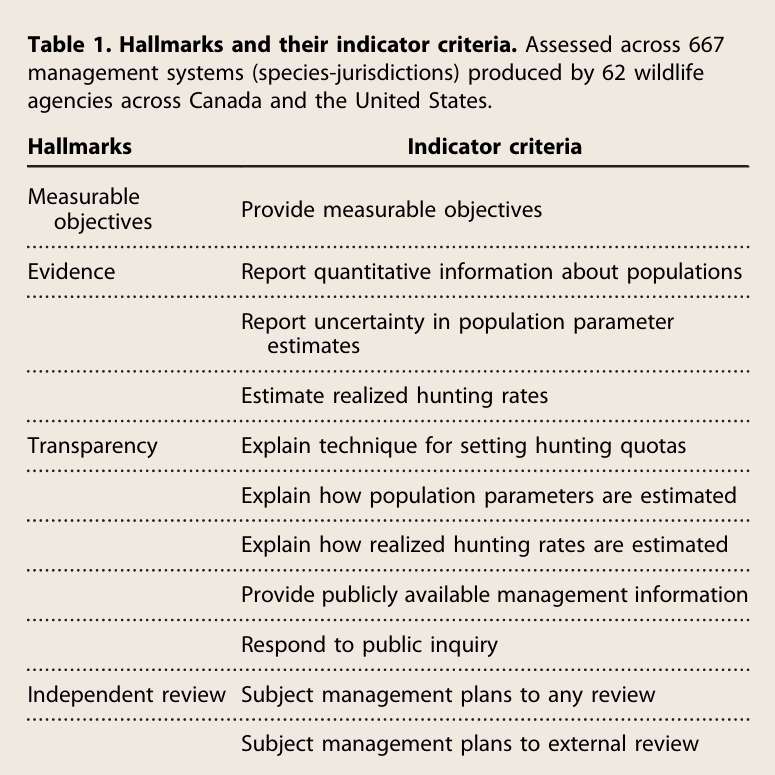
The chart above references criteria for identification purposes of Technical Reports as well as Research Papers, White Papers of validity, et al. If any one set of established criteria is not met, and/or questioned for validity, then we have a problem with the Science.
One good example is the universal North American Model, that hunters, trappers, ranchers, and many other Special Interest Groups and Lobbyists use fraudulently — to name a few who claim themselves as Conservationists, simply an untrue validation, and for several reasons , and question the validity of such claims, and their Science they use as evidence for their untruthful claims.
Despite widespread use and endorsement of the North American Model, however, its proponents and practitioners rarely articulate what science-based management entails. In addition, no one has comprehensively assessed whether assumptions or claims of Science-Based Management are supported by the model.
That knowledge gap is troubling given the “science-based” justifications for policy decisions commonly offered by agencies, the substantial public investments that support these agencies, and the considerable influence that hunting can have on otherwise self-regulating wildlife populations. In many taxa, adult mortality from hunting exceeds mortality from all other predators combined.
Our results provide limited, to no support what so ever, for the assumption that Wildlife Management in North America is guided by science. Most management systems lack indications of the basic elements of a scientific approach to management, or, did not meet the standards provided by the Table above (i.e. mandatory basic standards for approval of a Scientific Paper and/or Research as documented for decision making).
This can give you, the general public, knowledgeable information in regard to what myself and others discuss, when we highlight in our discussions that hunting, trapping, et al., are simply misinforming the Public with their own fraudulent Disinformation Campaigns. For more details on this subject, one must explore the realms of the references given at the end of this article, mandatory for information, and future discussions with those who want to convince you, Harvesting of Wildlife control Population and is a Conservation Approved Technique. It is not, and is simply untrue, and lacks qualification by Science itself.
When many States, for example, discuss abundance of populations or quantitative populations via data gathered (many inconsistent and conflicted within their own technical reports or population dynamics), as well the importance of evidence in determining reliable baselines, assessing population dynamics and management outcomes, and buffering against inherent uncertainties in management, not in much of their science, nor clarified within provable population numbers nor data, inherently left-out, obviously.
As Advocates, we have a responsibility to get involved, with the Truth. If they fear the truth, many will demean us, or tag us with a name such as Environmentalists, or Tree Huggers (LOL as if that is a bad thing( which in their minds, and to. them it is. This shows us how wayward they are in their ignorance, which is a tool they attempt to use when telling us they are Conservationists.
Much more can be discussed, and over time we will do so. This is a very serious subject, as much of our Wildlife Management System, and supposedly workable-dynamics, remain predicated on a lot of Science, that is basically bogus, and destructive – Over-Hunting — Thrill Kills of Miscellaneous necessary Wildlife — Management Tools developed from Hatred and Animosity toward other Groups and Wildlife — and the list goes on . . . With Truthful Science not within any of that criteria . . .
Evidence: Our Public Lands that have been desertified at 82% domestically – the current Wildlife Extinction Rate – Wildfires that were unnecessary – the Fear-Based Logic in the Killing of Keystone Predators – the supposed Conservation Logic of Ranching on Our Public Lands and the free-for-all attitude of destroying them while telling us everything is okay . . . Just a few deplorable circumstances that exist today.” — John Cox, M.A. C/M
__________________________
References:
1. S. G. Clark, C. Milloy, in Large Carnivore Conservation, S. G. Clark, M. B. Rutherford, Eds. (University of Chicago Press, 2014), pp. 289–324.
2. V. Geist, S. P. Mahoney, J. F. Organ, Why hunting has defined the North American Model of Wildlife Conservation, in Transactions of the 66th North American Wildlife and Natural Resources Conference (Wildlife Management Institute, 2001), vol. 66, pp. 175–185.
3. J. F. Organ, V. Geist, S. P. Mahoney, S. Williams, P. R. Krausman, G. R. Batcheller, T. A. Decker, R. Carmichael, P. Nanjappa, R. Regan, R. A. Medellin, R. Cantu, R. E. McCabe, S. Craven, G. M. Vecellio, D. J. Decker, The North American Model of Wildlife Conservation (The Wildlife Society Technical Review 12-04, The Wildlife Society, 2012).
4. C. T. Darimont, C. H. Fox, H. M. Bryan, T. E. Reimchen, The unique ecology of human predators. Science 349, 858–860 (2015).
5. P. J. Sullivan, J. M. Acheson, P. L. Angermeier, T. Faast, J. Flemma, C. M. Jones, E. E. Knudsen, T. J. Minello, D. H. Secor, R. Wunderlich, B. A. Zanetell, Defining and implementing—Best available science for fisheries and environmental science, policy, and management. Fisheries 31, 460–465 (2006).
6. J. R. Platt, Strong Inference. Science 146, 347–353 (1964).
7. H. Doremus, Scientific and political integrity in environmental policy. Tex. L. Rev. 86, 1601–1653 (2008).
8. G. K. Meffe, P. D. Boersma, D. D. Murphy, B. R. Noon, H. R. Pulliam, M. E. Soulé, D. M. Waller, Independent scientific review in natural resource management. Conserv. Biol. 12, 268–270 (1998).
9. K. Reckhow, Importance of scientific uncertainty in decision making. Environ. Manage. 18, 161–166 (1994).
10. C. Mora, R. A. Myers, M. Coll, S. Libralato, T. J. Pitcher, R. U. Sumaila, D. Zeller, R. Watson, K. J. Gaston, B. Worm, Management effectiveness of the World’s Marine Fisheries. PLOS Biol. 7, e1000131 (2009).
11. M. Mangel, in Whaling in the Antarctic (Australia v. Japan) (Memorial of Australia (International Court of Justice), 2011), vol. 1, pp. 334–388.
12. M. P. Nelson, J. A. Vucetich, P. C. Paquet, J. K. Bump, An inadequate construct? Wildl. Prof. 5,58–60 (2011).
13. C. T. Darimont, B. F. Codding, K. Hawkes, Why men trophy hunt. Biol. Lett. 13, 20160909 (2017).
14. K. A. Artelle, S. C. Anderson, A. B. Cooper, P. C. Paquet, J. D. Reynolds, C. T. Darimont, Confronting uncertainty in wildlife management: Performance of grizzly bear management. PLOS ONE 8, e78041 (2013).
15. C. T. Darimont, K. A. Artelle, F. Moola, P. C. Paquet, Trophy hunting: Science on its own can’t dictate policy. Nature 551, 565 (2017).
16. N. L. Gutiérrez, R. Hilborn, O. Defeo, Leadership, social capital and incentives promote successful fisheries. Nature 470, 386–389 (2011).
17. N. Turner, Ancient Pathways, Ancestral Knowledge: Ethnobotany and Ecological Wisdom of Indigenous Peoples of Northwestern North America (McGill-Queen’s Univ. Press, 2014).
18. C. Carroll, B. Hartl, G. T. Goldman, D. J. Rohlf, A. Treves, J. T. Kerr, E. G. Ritchie, R. T. Kingsford, K. E. Gibbs, M. Maron, J. E. M. Watson, Defending the scientific integrity of conservation-policy processes. Conserv. Biol. 31, 967–975 (2017).
19. J. B. Ruhl, J. Salzman, In defense of regulatory peer review. Washington Univ. Rev. 84,1–61 (2006).
20. K. Wilson, J.-M. Gaillard, B. Sheldon, Transparency and evidence-based policy: An open letter to Defra from Journal of Animal Ecology, 2014; https://journalofanimalecology. wordpress.com/2014/11/04/transparency-and-evidence-based-policy-an-open-letter-to defra-from-journal-of-animal-ecology/.
21. S. S. Soomai, The science-policy interface in fisheries management: Insights about the influence of organizational structure and culture on information pathways. Mar. Policy 81, 53–63 (2017).
22. R. S. Waples, M. Nammack, J. F. Cochrane, J. A. Hutchings, A tale of two acts: Endangered species listing practices in Canada and the United States. BioScience 63, 723–734 (2013).
23. R. B. Gill, The wildlife professional subculture: The case of the crazy aunt. Hum. Dimens. Wildl. 1,60–69 (1996).
24. C. T. Darimont, P. C. Paquet, A. Treves, K. A. Artelle, G. Chapron, Political populations of large carnivores. Conserv. Biol. 10.1111/cobi.13065 (2018).
25. H. Skaug, D. Fournier, A. Nielsen, A. Magnusson, B. Bolker, Generalized linear mixed models using AD Model Builder version 0.8 (2013).
26. R Core Team, R: A Language and Environment for Statistical Computing (R Foundation for Statistical Computing, 2016).
27. A. Gelman, Y.-S. Su, M. Yajima, J. Hill, M. G. Pittau, J. Kerman, T. Zheng, V. Dorie, arm: Data analysis using regression and multilevel/hierarchical models (2016).
28. A. Gelman, Scaling regression inputs by dividing by two standard deviations. Stat. Med. 27, 2865–2873 (2008).
29. Conservation Measures Partnership, Open Standards for the Practice of Conservation (Conservation Measures Partnership, 2013); http://cmp-openstandards.org/wp-content/ uploads/2014/03/CMP-OS-V3-0-Final.pdf.
30. D. G. Kleiman, R. P. Reading, B. J. Miller, T. W. Clark, J. M. Scott, J. Robinson, R. L. Wallace, R. J. Cabin, F. Felleman, Improving the evaluation of conservation programs. Conserv. Biol. 14, 356–365 (2000).
31. S. Riley, W. Siemer, D. Decker, L. Carpenter, J. Organ, L. Berchielli, Adaptive impact management: An integrative approach to wildlife management. Hum. Dimens. Wildl. 8, 81–95 (2003).
32. L. V. Dicks, J. C. Walsh, W. J. Sutherland, Organising evidence for environmental management decisions: A ‘4S’ hierarchy. Trends Ecol. Evol. 29, 607–613 (2014).
33. J. C. Walsh, thesis, University of Cambridge (2015).
34. J. C. Walsh, L. V. Dicks, W. J. Sutherland, The effect of scientific evidence on conservation practitioners’ management decisions. Conserv. Biol. 29,88–98 (2015).
35. S. Legge, A plea for inserting evidence-based management into conservation practice. Anim. Conserv. 18, 113–116 (2015).
36. W. J. Sutherland, A. S. Pullin, P. M. Dolman, T. M. Knight, The need for evidence-based conservation. Trends Ecol. Evol. 19, 305–308 (2004).
37. M. Keene, A. S. Pullin, Realizing an effectiveness revolution in environmental management. J. Environ. Manage. 92, 2130–2135 (2011). Artelle et al., Sci. Adv. 2018;4:eaao0167 7 March 2018
38. H. M. Regan, Y. Ben-Haim, B. Langford, W. G. Wilson, P. Lundberg, S. J. Andelman, M. A. Burgman, Robust decision-making under severe uncertainty for conservation management. Ecol. Appl. 15, 1471–1477 (2005).
39. National Research Council, Improving the Use of the “Best Scientific Information Available” Standard in Fisheries Management (The National Academies Press, 2004).
40. S. Jasanoff, Transparency in public science: Purposes, reasons, limits. Law Contemp. Probl. 69,21–45 (2006).
41. A. Treves, G. Chapron, J. V. López-Bao, C. Shoemaker, A. R. Goeckner, J. T. Bruskotter, Predators and the public trust. Biol. Rev. 92, 248–270 (2017).
42. W. M. Adams, C. Sandbrook, Conservation, evidence and policy. Oryx 47, 329–335 (2013).
43. P. Horwitz, M. Calver, Credible science? Evaluating the regional forest agreement process in western Australia. Aust. J. Environ. Manage. 5, 213–225 (1998).
44. G. Chapron, A. Treves, Blood does not buy goodwill: Allowing culling increases poaching of a large carnivore. Proc. R. Soc. B 283, 20152939 (2016).
K. A. Artelle, J. D. Reynolds, A. Treves, J. C. Walsh, P. C. Paquet, C. T. Darimont, Hallmarks of science missing from North American wildlife management. Sci. Adv. 4, eaao0167 (2018).