Author: Photographer — Journalist

  • BLM Kills Wild Horses: Criminal Behavior on America’s Public Lands Nation Wide

    john_babe_5Article John Cox, Cascade Mountains

    “We can easily forgive a child who is afraid of the dark; the real tragedy of life is when men are afraid of the light.” ― Plato

    Currently a government agency, the Bureau of Land Management, is liquidating America’s Wild Horse Herds at an unprecedented rate.  Within Oregon State, for example, we find the Bureau of Land Management improperly and illegally liquidating Wild Horse Herds in total.

    The BLM is, in fact, managing America’s horse herds illegally — nation wide.  The BLM Staff is also allowed to generate false information to the public about their approach to wild horse herd management and care.  It does not take much investigation into this matter to reference and see for oneself that their management situation is in direct opposition to the several mandated Federal Laws that governs and regulates their activity.  The BLM ignores these Federal Laws often.

    One of the outstanding facts that remains more obvious is the Environmental Assessments distributed by the BLM. The fact is, as present Federal Court rulings show as well, that the Environmental Assessments are not done within a current time-frame, but simply copied most often from other EA’s from years past — so they got-away with a false premise to an Environmental Assessment, so within the BLM’s employees mind-set, they can get away with misinfoprmation again and again. . . and why not, nobody checks, until now that is! FRIENDS OF ANIMALS, and PROTECT MUSTANGS, Plaintiffs, v. THE UNITED STATES BUREAU OF LAND MANAGEMENT, an agency of the United States, Defendant. THE UNITED STATES DISTRICT COURT, DISTRICT OF NEVADA — 3:15-CV-0057-LRH-WGC . . .

    Rather than have Range Managers or Biologists and Researchers lead the BLM, we have business people and politician’s directly involved in placing the leadership. So why would it be surprising that criminal activity transpires, and then ignored by today’s politicians.

    “And not only the pride of intellect, but the stupidity of intellect. And, above all, the dishonesty, yes, the dishonesty of intellect. Yes, indeed, the dishonesty and trickery of intellect.” ― Leo Tolstoy, Anna Karenina

    Across the United States there exist much more BLM controversy, with ongoing questionable, abusive, and illegal wild horse management situations.  Within the scope of this particular discussion, we are using a micro area of BLM horse management activity.  None the less, the legal boundaries prescribed by Law remain, and perusing the Wild Horse and Burro Act of 1971 (i.e. http://en.wikipedia.org/wiki/Wild_and_Free-Roaming_Horses_and_Burros_Act_of_1971), among others, will more than show proof of BLM’s constant violations.

    Of note: The act was challenged in court for being unconstitutionally vague and unconstitutionally overbroad. The United States Court of Appeals for the Ninth Circuit upheld the act in all regards in United States v. Johnson, 685 F.2d 337 (9th Cir. 1982). See: Iraola, p. 1072 . . . The “premise” of which states clearly, in summation here, that the BLM must show either destruction of Public Lands by the Wild Horses, or outright safety violations of the Wild Horses in order to conduct a Wild Horse Herd Roundup — but this simply does not happen, and one can attest to the fact that all Roundups up to this point are and have been illegal, and not in accord with the Wild Horse and Burro Act what so ever; as well, as many sections of FLPMA, NEPA, and the Taylor Grazing Act — But awkwardly ignored by not only upper BLM management, but politician’s as well — and the concern toward Conflict of Interests remain quite burdensome — similar to Rome right before it failing . . .

    You can also peruse other regulatory and legal situations that the BLM also is in conflict and abusing: FLPMA (i.e. http://www.blm.gov/flpma/FLPMA.pdf ), The Taylor Grazing Act (i.e. http://en.wikipedia.org/wiki/Taylor_Grazing_Act_of_1934 ), and prescribed by law the Environmental Impact Statements required, abused, and even accomplished within a fraudulent and illegal manner on many occasions.
    oregon1

    Questionable and Illegal Activity at Best

    Keep in mind the BLM (i.e. and the Department of the Interior) receives an outstanding amount of tax payer dollars, or budget, for the care and management of these herds, specifically within what is termed HMA (Horse Management Areas).  The BLM’s budget the past couple of years has developed into well over $1.5 billion dollars, and they lose money every year, despite their stating they make a profit (i.e. G.A.O. findings of notable fact).  These Public Lands are set aside for the care and security of these wild horse herds and by Law.

    The “outcropping” of situations on these Public Lands shared with the wild horse herds, such as Welfare Ranching, which exceeds in administrative costs alone, i.e. tax payer money, of $490 million dollars per year, according to current G.A.O. figures, remains contrary at best to the safety of America’s wild horse herds on these HMA’s.
    oregon8

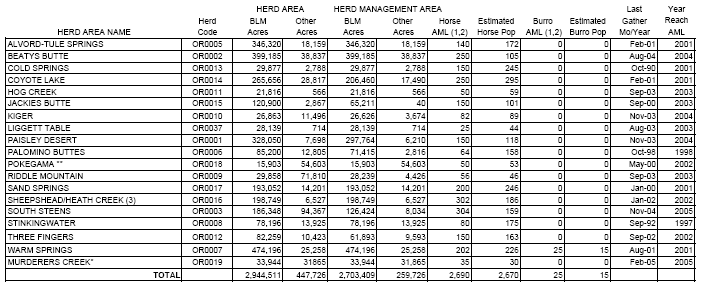
    **Here are current Horse Management Areas in the State of Oregon. Numbers ambiguous at best, and counts unspecific in accord with the Taylor Grazing Act, FLIPMA, Environmental Impact Statements, or any other Legal situation pertaining to the management of these areas — Especially the Wild Horse and Burro Act in regard to sound management principles’ and actions. . . (Enlarge to peruse)

    Illegal Activity

    In Oregon, for example, these Welfare Ranchers are allowed to collect and sell (by BLM administrators and supervisors) wild horses form the HMA’s abundantly, and when they supposedly need cash.  Their situation is called a “Stakeholder Paradigm” by BLM staff, and these same ranchers allowed to run slip-shod on the Oregon HMA’s by BLM supervisors.  This precise activity is illegal, and mentioned within the WH&BA as undisputable fact being illegal (outlined below).

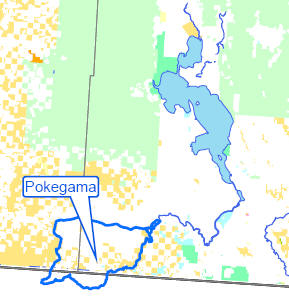
    Within the past few months no assigned HMA roundup was designated within the Pokegama HMA area, although we  have witnesses attesting to a roundup situation.  Was it ranchers grazing their cattle on Public Lands (i.e. our lands) or BLM staff selling horses to kill-buyers for slaughter?

    “I seen them loading a livestock trailer with horses.  I was hunting in the area, stopped and asked what was going on.  A fellow in a brown BLM shirt and hat told me to move on, and that they were just thinning the wild horses out in the area so we could have more deer around for hunting,” Steve Connolly stated, while his hunting partner nodding in agreement – Mike Smith, Oregon residents, among others who witnessed the occasion.

    While having lunch in a local restaurant, I also spoke with a Keno, Or. resident about the wild horse herds on the HMA.  later I went and seen for myself the freeze-brands from the BLM.  “Oh sure,” he stated, “. . . we just go out and take what the ranchers have left when they do a gather.  Kind of keeps us quiet about their situation, I guess.  I culled three horses over the past couple of years.  I break them for the trail, and they are damn good horses,” remains Anonymous until called upon.

    BLM Cannot Provide Accurate Data for Roundup Requirements

    The Bureau of Land Management is restricted in regard how they manage America’s Wild Horse Herds, and by strict Laws.  BLM ignores these laws.

    The law is covered in the “Wild and Free-Roaming Horses and Burros Act of 1971” (i.e. discussed and defined here: http://en.wikipedia.org/wiki/Wild_and_Free-Roaming_Horses_and_Burros_Act_of_1971) with proper citation and Federal Court Rulings.  With this in mind, the HMA’s have horses disappearing or rounded up, and no legitimate reasoning as to why.
    oregon9

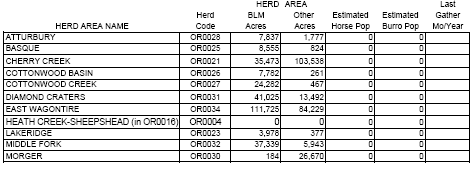
    ** These areas were zeroed-out, in Oregon, with no excuse as to why and given by BLM Management within these area.  Ambiguity exists, but what is known is the fact BLM within these areas, conjecture at this point via many statements by those who live and work in the surrounding areas, state clearly the ranchers in these areas had free-reign to take wild horses from these areas whenever they wanted to do so (Enlarge to peruse).

    The Law is quite clear, yet nothing reported in regard to not only where the horses disappeared to, from the zeroed-out HMA’s, or the false numbers within the current managed HMA’s, but obviously false and improper reasoning and excuses given as well for the discrepancies.  The BLM attitude toward the public is notable over the years as “bad” to “arrogantly abusive” toward tax payers in general.  The truth about roundups and wild horses BLM staff passes to the public, nation wide, are always in error, misinformation, or simply lies, at best.  When questioned they simply hide behind the shroud of government agency compliance.

    WH&BA-1971 Specifically, 1338. Criminal provisions (a) Violations; penalties; trial Any person who–

    (1) willfully removes or attempts to remove a wild free-roaming horse or burro from the public lands, without authority from the Secretary, or

    (2) converts a wild free-roaming horse or burro to private use, without authority from the Secretary, or

    (3) maliciously causes the death or harassment of any wild free-roaming horse or burro, or

    (4) processes or permits to be processed into commercial products the remains of a wild free-roaming horse or burro, or

    (5) sells, directly or indirectly, a wild free-roaming horse or burro maintained on private or leased land pursuant to section 1334 of this title, or the remains thereof.” http://www.animallaw.info/statutes/stusfd16usc1331_1340.htm#§ 1338 . . .

    Questions With No Answers From the BLM

    The question remains, are Stakeholders, in this case welfare ranchers, given the right to complete a gather or roundup of wild horses?  Absolutely not, and is illegal, and the BLM staff is obligated to take to task, arrest those who violate this situation — IT IS A LAW!  And yet —

    Are BLM staff allowed to gather horses from the HMA, randomly?  Absolutely not, this is covered by the Wild Horse and Burro Act, A LAW, and truthful purpose derived from truthful data must be given in regard as to why the gather or roundup will take place.  Yet another anomaly, and BLM does not give truthful data or reasoning even within the best of circumstances.

    “We have a guy from the BLM who drinks here often.  He comes in and let’s us know when the ranchers or the BLM is doing a gather, so we can get a horse or two.  They just take them to slaughter anyway.” Anonymous until required to testify.

    Conclusion

    Keep in mind the charts above simply outline the counts within HMA’s in the State of Oregon.  Many other states have similar graphs and counts, and not so ironic, the BLM counts are also just as inaccurate, when checked, as those included here.  Consistency in illegal and fraudulent activity (Fraud — is used here to describe obtaining tax payer dollars within an illegal manner and illegal context).

    The resolution to such behavior?  The BLM needs to stop doing things illegally, and the only way that will come about is by arresting those involved.  They have taken advantage of taxpayer money often, within a fraudulent manner as prescribed by law, and indeed wasted taxpayer money often.  Their system is corrupt and has been for quite some time.

    This particular discussion will end by giving the Congressional reasoning for the Wild Horse and Burro Act of 1971, as well as the reasoning for establishing HMA’s across the United States.

    You decide whether the BLM is conducting legitimate management of America’s Wild Horse Herds, or simply conducting and allowing criminal activity to develop progressively more so on America’s Public Lands!  At the heart of it all, the termination of America’s Wild Horse Herds — this is too much to sacrifice for blatant criminal behavior in a government agency:

    “1331. Congressional findings and declaration of policy”

    “Congress finds and declares that wild free-roaming horses and burros are living symbols of the historic and pioneer spirit of the West; that they contribute to the diversity of life forms within the Nation and enrich the lives of the American people; and that these horses and burros are fast disappearing from the American scene. It is the policy of Congress that wild free-roaming horses and burros shall be protected from capture, branding, harassment, or death; and to accomplish this they are to be considered in the area where presently found, as an integral part of the natural system of the public lands.” http://www.animallaw.info/statutes/stusfd16usc1331_1340.htm#§ 1331

    __________________________________________

    For more discussion or reference:

  • American’s Want Our Public Lands Back: Return Our Wild Horses to Public Lands

    old_collapsed_strutures_mohave_desert1Time to Give Back Our Public Lands to Americans’

    The federal government owns too much land in the West.  An understatement indeed!  The fact is it has created a situation of mismanaged Public Lands that remain costly to taxpayers.  Criminal activity is abundant, and welfare ranchers receive extremely large amounts of taxpayer money unnecessarily.

    The federal government owns approximately one third of the land in the continental U.S.1  This amounts to over one half of the land in the western states.  Some percentages of federal land in western states are: Arizona 45%, Idaho 61%, Nevada 79%, Utah 60% New Mexico 33%, and Montana 30%.

    The only people profiting from this amount of Public Lands are welfare ranchers and corporations, and make huge profits at taxpayer expense!  At the same time government agencies tell the common folks, who’s land it truthfully belongs to, i.e. the American taxpayers — to go to hell constantly.  These agencies ignore law and policy in regard to our Public Lands — this creates many difficult situations in regard to wildlife and our environment.

    Welfare Ranching and the LAW

    This situation of welfare ranchers and the law is not as complicated as one would expect, and especially something that welfare ranchers themselves do not want the general public to know as common knowledge.  The fact is this, Grazing on public lands is a privilege, and not a right,4 as well there exist responsibilities to maintain this privilege, and just as often ignored.

    The Taylor Grazing Act also makes it quite clear to those who use Public Lands to graze their cattle, stating that grazing preferences” shall not create any right, title, interest, or estate in or to the lands” belonging to the U.S. Government.4  Yet another situation ignored in total due to lobby groups persuasive money-oriented deceptions, lies, and profound intimidation techniques toward anyone not owning cattle or sheep.  Citations from Federal Court, Federal Judge comments, et al., also back the Taylor Grazing Act within many different perspectives, also favorable to the public rather than welfare ranchers, and for reasons this journalist has given further in this article.

    So welfare ranchers go about their business, costing taxpayers, last GAO estimate over $450 million dollars in administrative expenses alone and in 2011, increased in 2012.  GAO has also estimated an $82 billion dollar loss over the previous 5 year tax and fee collection period, uncollected fees or generated in stipends and payment to welfare ranchers out of taxpayer money.

    We discover further, “Congress has not conferred upon citizens the right to graze stock upon the public lands. The government has merely suffered the lands to be so used.”5

    We also discover this, and wonder why our government agencies, who indeed work for us and not welfare ranchers, have not revoked this well cited and documented law by Federal Court, being a privilege, not a right as they say, (“. . . license to graze on public lands has always been a revocable privilege.”  Grazing permits have remained a privilege and for several reason outlined within these cited court cases, but as usual the DOI and BLM and Justice Department attorney’s ignore these situations, allowing welfare ranchers to raise havoc with our wildlife and destroy ecological systems on our Public Lands.  Time for this to cease immediately.

    Further case law and citations develop an even more clear and definable situation within welfare rancher’s awkward, but none the less leased grazing lands.  We find their false representation to be disgusting and playing the general public and taxpayers as fools, pretending their false information as truth.  And why not, they speak to one another, as they are getting very rich on the backs of taxpayers, with monetary amounts increasing yearly.

    Here is further reference in regard to welfare ranchers and their grazing permits — very different than what they tell the public their rights on Public Lands actually are and that exist today: Osborne v. United States, 145 F.2d 892, 896 (9th Cir. 1944) (“it has always been the intention and policy of the government to regard the use of its public lands for stock grazing. . . as a privilege which is withdrawable at any time for any use by the sovereign without the payment of compensation”); Diamond Bar Cattle Co. v. U.S.A., 168 F.3d 1209, 1217 (10th Cir. 1998) (permittees “do not now hold and have never held a vested private property right to graze cattle on federal public lands”); Alves v. U.S., 133 F.3d 1454 (Fed. Cir. 1998) (holding that neither grazing permit nor preference is a compensable property interest).

    Public Lands Grazing Law and Environment

    “Cattle are a non-native species to the environments and on Public Lands. Since cattle are non-natives, their impact on the environment is greater than native species like elk and deer.  Cattle have not evolved in the ecosystems in which they have been placed, and therefore they do not co-exist with those ecosystems well. Whereas deer and elk are highly mobile foragers, cattle are stagnant foragers. What this means [a.n. and when predators such as the wolf create healthy ecological systems] is that deer and elk move around so much that they do not overgraze an area or cause soil damage.  Cattle on the other hand, will often remain in the same area until they have eaten all or most of the edible material there.  Only after most of the vegetation has been eaten will they move on.”7  But Cattle also require more forage than elk or deer, and wreck havoc on ecological systems, especially along streams and in native woodlands.

    And, not so surprising, we find again the BLM and DOI ignoring not only their own policies in regard to welfare ranchers and sound management of welfare rancher’s cattle on Public Lands, but laws broken directly, and not hiding the situation at all.8

    The general public, or taxpayers, who are aware of welfare ranchers and most all believe  the situation being criminal, deceptive, and environmentally unsound, all want to know why these welfare rancher’s have not had their permits revoked.  Their attitudes toward wildlife, wild horses and wolves the most current and controversial of issues, are allowed to portray themselves as owners’ of Public Lands?  This even to the point of threatening State Law enforcement officials, in Washington State for example, that they will start killing wolves on their own (willfully ignoring the Law), who trespass onto (Their) land — which in reality and by Law Public Lands and the wolves rightful home.9  So one has to wonder if the Washington State law enforcement, as in other States as well, will simply ignore their threat and allow them to shoot wolves on sight, and from Public Lands, pretending in pretense the welfare ranchers own Public Lands — or commit to protecting Public Lands from the welfare ranchers and in accord with Federal Laws?

    Yes, we have a big problem here with welfare ranchers and their perceptions!  All the while doing this on Our Public Lands, not theirs!  So once again we find welfare ranchers ignoring the laws and policies, that have been placed into law to garner a proper respect for America’s PublicLands, as well as management of our wildlife, environmental systems, and land use, but ignored in total.  When is enough-enough?

    Livestock Grazing and the BLM

    Where do the wild horse herds go from here?  Well, back onto our Public Lands.  As they were taken off, one can assume, illegally.  And it is that simple when referencing the laws and policies that direct BLM and even the DOI in Public Lands management.  Below reference for public discussion and debate — which this Journalist will not dally with opinion, but reference the laws and Federal Court statements directly below.

    “BLM has regulatory authority to protect the land from overgrazing: BLM regulations impose additional requirements, including that “authorized livestock grazing use shall not exceed the livestock carrying capacity of the allotment.” 43 C.F.R. § 4130.3-1(a). The regulations define “livestock carrying capacity” as “the maximum stocking rate possible without inducing damage to vegetation or related resources.” 43 C.F.R. § 4100.0-5. See Idaho Conservation League & WWP v. Steele, Case No. 01-529-E-BLW (D. Idaho).”

    “Under the “Fundamentals of Rangeland Health” regulations must not impair watershed function, riparian habitat, water quality, or wildlife habitat. The FRH regulations require that BLM must revise grazing management “as soon as practicable,” and in any event no later than the start of the next grazing season, upon making determinations that the FRH Standards and Guidelines are not being met upon an allotment. 43 C.F.R. §§ 4180.1 & 4180.2(c); see also Idaho Watersheds Project v. Hahn, 187 F.3d 1035 (9th Cir. 1999) (enforcing this FRH requirement).”

    “BLM’s regulations provide that “appropriate actions” to take in response to FRH violations include “implementing actions pursuant to subparts 4110, 4120, 4130, and 4160 of this part that will result in significant progress toward fulfillment of the standards and significant progress toward conformance with the guidelines.” 43 C.F.R. § 4180.2. Of these referenced subparts, 43 C.F.R. § 4110.3-2(b) expressly provides: “When monitoring or field observations show that grazing use or patterns of use are not consistent with the provisions of subpart 4180 [the FRH requirements] . . . the authorized officer shall reduce permitted grazing use or otherwise modify management practices.” See LU Ranching v. Babbitt v. IWP, No. CV-00-285-EJL (D. Idaho), Memorandum Decision and Judgment entered April 12, 2001(rejecting permittee challenges to BLM decision made under FRH regulations).”

    “See 43 C.F.R. § 4110.3-2(b) (emphasis added). Moreover, it is “[m]andatory” that BLM incorporate into grazing permits “terms and conditions that ensure conformance with subpart 4180 [the FRH requirements].” 43 C.F.R. 4130.3-1 (c). BLM’s regulations further specify that the agency may revise grazing permits and make cuts in grazing based on “monitoring, field observations, ecological site inventory or other data acceptable to the authorized officer.” 43 C.F.R. § 4110.3.”

    Conclusion

    There is no doubt welfare ranchers break laws and policies daily.  A simple perusal of this article and legal quotes strongly show their activity to be quite illegal.  There is no doubt the Department of the Interior and the Bureau of Land Management assist the welfare ranchers in their illegal activity, simply by allowing it and saying nothing.  BLM will also pretend to ignore the situation, but not so ironic, the situation very obvious even to those uninvolved.

    Conclusively, it is time to take ALL grazing permits away from the welfare ranchers, as they have conducted continuous and illegal operations on Public Lands for too long.  Public Lands belong to Americans’ — not to corporations and welfare ranchers.  American’s want our Public Lands back, enough of this deceptiveness, lies, and bully tactics by lobby groups!_____________________________________

    1. Zachary A. Smith, The Environmental Policy Paradox, (Englewood Cliffs, NJ Prentice Hall, 1995), p. 179

    2. John Freemuth, “Federal Land Management in the West:, in Zachary A. Smith, editor, Environmental Politics and Policy in the West, (Kendall/Hunt Publishing Company, Debuque, Iowa, 1993), p. 202.

    3. Personal Interview, Gary Hase Jr., Natural Resource Manager II, Range Section, Land Department, State Forestry Division, 20 April 1995.

    4. See 43 U.S.C. § 315b & 16 (1943 Taylor Grazing Act, stating that grazing preferences “shall not create any right, title, interest, or estate in or to the lands” belonging to the U.S. Government) all amendments inclusive.

    5. 43 U.S.C. § 580l (FLPMA similar provision); Omaechevarria v. Idaho, 246 U.S. 343, 352 (1918).

    6. U.S. v. Fuller, 409 U.S. 488, 494 (1973) (grazing permittee does not acquire a property interest in grazing permit); Swim v. Bergland, 696 F.2d 712, 719 (9th Cir. 1983).

    7. Michael D. Hanneman, Effects of Cattle, Elk and Mule Deer on a Narrowleaf Cottonwood Riparian Community Under a Short Duration Grazing System in Northern Arizona, (Masters Thesis, Northern Arizona University, Flagstaff, AZ 1991), pp. 11-19.

    8. Protection of public lands from overgrazing is a key purpose of both FLPMA, 43 U.S.C. § 1701 et seq., and TGA, 43 U.S.C. § 315 et seq. See Public Lands Council v. Babbitt, 120 S.Ct. 1815, 1818-20 (2000) (discussing history and development of public lands law as applying to livestock grazing, BLM’s broad authority to protect public lands from damage due to livestock grazing); 43 U.S.C. § 1701(a)(8) (policy objectives of FLPMA).

    When Congress enacted FLPMA in 1976, it mandated that BLM “shall manage the public lands under the principles of multiple use and sustained yield. . . .” 43 U.S.C. § 1732(a). FLPMA defines “sustained yield” as meaning “the achievement and maintenance in perpetuity of a high-level annual or regular periodic output of the various renewable resources of the public lands consistent with multiple use.” 43 U.S.C. § 1702(h).

    9. the ESA provides that all federal agencies “shall utilize their authorities. . . by carrying out programs for the conservation of endangered species,” 16 U.S.C. § 1636(a)(1); and “[e]ach Federal agency shall, in consultation with and with the assistance of the Secretary, insure that any action authorized, funded, or carried out by such agency . . . is not likely to jeopardize the continued existence of any endangered species or threatened species or result in the destruction or adverse modification of habitat of such species. . . .” 16 U.S.C. § 1536(a)(2). The consultation requirement applies to grazing. Pacific Rivers Council v. Thomas, 936 F. Supp. 738, 745 (D. Idaho 1996). Watch out for Western Watersheds Project v. Matejko, No. CIV 01-0259-E-BLW (D. Idaho) (challenge to Forest Service and BLM failure to consult over 1000 irrigation and stockwater diversion on Salmon Challis National Forests).

    Also, “it is unlawful for any person subject to the jurisdiction of the United States to. . . take any such species. . . .” 16 U.S.C. § 1538(a). See IWP v. Bennetts, Civ. No. 00-729 (D. Idaho) (motion for summary judgment filed June 2002).