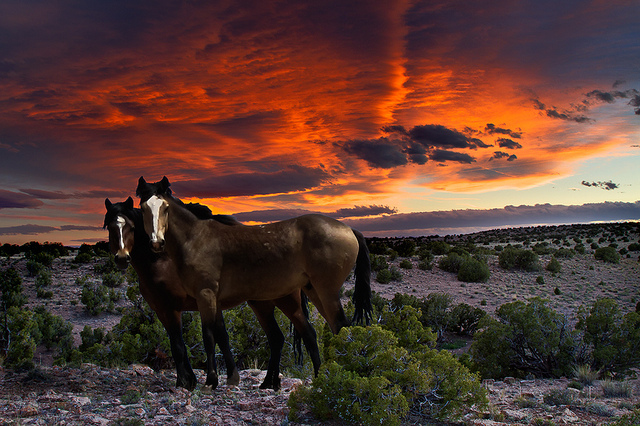
 “They are all beasts of burden in a sense, ‘ Thoreau once remarked of animals, ‘made to carry some portion of our thoughts.’ Animals are the old language of the imagination; one of the ten thousand tragedies of their disappearance would be a silencing of this speech.”
How large will be the loss of America’s Wild Horses on America’s Public Lands? Over what time period might that loss unfold? Habitat destruction and breed control is the leading cause of species extinction, and here we can actually see cattle, a distinct overabundance, being the problem on Public lands; which, leads to not only environmental destruction, but wildlife and in particular wild horse extinction!
Generally, many of the species found across large areas of a given habitat are represented, most often anyway, within smaller areas. So we can consider habitat loss initially causes few-extinctions. Then we go to cattle . . . then discover there are so many that the last remnants of Public Lands habitat are essentially being destroyed. Thus, at current rates of habitat destruction, the common belief is the peak of extinctions should not occur for decades – Unfortunately, what does exist is an uneven, highly clumped, distribution of vulnerable species over America’s public land surface. Within these ‘biodiversity hotspots (HMA’s in the matter of this discussion), habitats are already disproportionately reduced.
Wild Horses are in danger of becoming extinct!
Conservatively, there are about seven million species of animals — a definition encompassing most organisms that would be generally recognized as plants or animals but excluding bacteria, for instance — about 85% are terrestrial – wild horses such a small percentage, yet blamed for so much “occurrence” on Public Lands – outright lies actually, to defend the over abundance of cattle and other grazing livestock on Public Lands.
Humanity is rapidly destroying habitats that are most species-rich.
To convert habitat loss to species loss, the principles of island ecology (HMA’s being an island for example within this paradigm of explanation) are applied to the terrestrial ‘islands’ that remain in a ‘sea’ of converted land. The relationship between number of species and island area is nonlinear, and from this one can predict how many species should become extinct as the size of the islands shrinks. These doomed species do not disappear immediately, however.
How does one go about calculating the rate of species extinctions from habitat fragments? There have been only a few such estimates, but projections based on a species survivorship curve with a half-life of roughly 50 years, which seems reasonable. Combining the rate of habitat loss, the species-to-area relationship and the survivorship curve gives us a crude extinction curve. From this, we would expect that current extinction rates should be modest — on the order of a thousand species per decade, per million species – but the human-induced, for example here PZP and other breeding controls upon a deficient genetics availability, and special interests toward public lands given a priority . . . Note: Also due to roundups, taking to slaughter mostly stallions, mares disappearing from government corrals in total, and the use of a pesticide PZP which interrupts dynamic herd life and creates misaligned survivorship attributes and family / band disharmony – yes, destruction of the herd dynamics in total —
. . . i.e. many horse bands and herds, the extinction percentage increases 100-fold, and quickens the process to eventually a shorter-time-span of reaction-to-action curve – or extinction within just a few years . . .
The Wild Horses on Public lands is foremost in this matter, as well as wolves, bears, and cougars, as being destroyed — apparently a priority for the ignorant, the politicians that feed upon fear and hate, and those who simply follow such ravings – which are nothing more than distorted and disgusting lies brought about by Special Interest groups and lunatics.
Because the species–area curve is non-linear, the clearing to date (or the overwhelming destruction of Public Lands from cattle) of much of America’s Public Lands, are predicted to eliminate 42% of the species that they contain (some scientists predict much higher numbers as well as much faster). The time delays before extinction mean that many more species should be ‘threatened’ than have already become extinct; that is, they are thought likely to become extinct in the wild in the medium-term future. For example with the elimination of wild horses, wolves, cougars, et al., at least 12% of all plants and 11% of all birds will come into this category as well.
Of course, more cattle onto Public Lands x2 would eliminate the other 85% of species that they contain. The extinction curve should accelerate rapidly to a peak by a decade or two if the rate of livestock increase and destruction of Public Lands remains constant. But it will be upon us sooner if that rate increases as it has been for a few years now — as seems probable.
Oddly Beef remains at 28% product thrown away (not consumed), with 4% thrown away in commercial process, and another 7% lost in transport – Yes, we apparently have an over-abundance of beef in America . . .
Once the extinction peak has passed, the extinction curve declines, perhaps into the twenty-second century as species are lost from the remaining fragments of habitat. The relative height of the peak depends critically on the amount of habitat that remains. A value of 5% of remaining habitat would protect about 50% of all the Public Lands species; smaller percentages would lead to smaller estimates of surviving species.
Habitat destruction areas remain blatantly obvious — Species found only within the areas are themselves destroyed, then eliminated, just as the habitat around them.
One observation interesting, when we considerer HMA’s within a biological paradigm – whereby, species with small ranges are typically scarcer within their ranges than are more widely distributed species, making them yet more vulnerable.
Consequently, even random destruction would create centers of extinction that match the concentrations of small-ranged species — the hotspots. So the ideology of the HMA’s on Public Lands, when first developed were very protective areas, but when manipulated, in this case for Special Interests, these HMA’s become burdensome, even dangerous to the Wild Horses as well as other animals moving toward extinction . . . Look at the term Feral once out of an HMA – a term changed with the WH&B Act to accommodate welfare ranching is all . . .
Worse, however, the HMA’s destruction, as it becomes obvious through consistency, may not have been random at all — rather malevolent. In the HMA areas designated as Wild Horse Safety Zones basically, cattle, rather than Wild Horses become the majority influence upon the Public Lands areas just by sheer numbers alone; only 12% of the original primary vegetation remains within many of the cattle grazing permit areas, compared with about 50% Public Lands as a whole.
Ironically, even within those HMA’s, the areas richest in endemic plant species — species that are found there and only there and only cattle graze and horses do not graze — have proportionately the least remaining vegetation and the smallest areas currently protected.
Applying the species–area relationship to the individual hotspots gives the prediction that 18% of all their species will eventually become extinct if all of the remaining habitats within HMA’s were quickly protected. These HMA’s, deductively, would eventually lose about 40% of all their species.
All of these projections ignore other effects on biodiversity, such as the possibly adverse impact of global warming, and further introduction of more alien species, for example sheep or goats, which is a well-documented cause of extinction of native species as well. Elk, for example, have obtained a virus from Goats feces that are fatal to Elk, et al and the virus transmitted through other infected Elk . . . Yet Cougar and Wolves blamed for Elk destruction – demonstrates beyond a doubt the iron-clad grip of lies and ignorance within our management of wildlife today . . .
ACTION REQUIRED
Unless there is immediate action to salvage the remaining and currently unprotected HMA’s and Wild Horses and their areas, the species losses will more than double. When this happens the Wild Horses will be Extinct – NONE LEFT!
There is, however, a glimmer of light in this gloomy picture. High densities of small-ranged species make many species vulnerable to extinction. But equally this pattern allows both minds and budgets to be concentrated on the prevention of nature’s untimely end. Protecting them is necessary, but not sufficient – consider they are supposedly protected currently, but that is the lie of all lies – as Wild Horses are not protected at all!
Unless we as a civilization start considering the “truth” rather than lies of convenience for the wealthy and special interests, we will see not only wild horses become extinct, but many, many other wildlife as well as many other environments / biospheres – Conclusively, ignorance is not the path toward humane reasoning – rather, truth is the pathway to sound judgment, good management, and prolific living circumstances in America and abroad . . .
And need I say, the ability to walk out into nature, into areas with wild life, horses, predators and everything we dream about that exits, and actually pause for a moment and see them alive, in their habitat – being as one – with nature . . .
__________________________________
References
Myers, N. , Mittermeier, R. A. , Mittermeier, C. G. , da Fonseca, G. A. B.& Kent, J. Nature 403, 853–858 (2000).
May, R. M. in Nature and Human Society (ed. Raven, P. H.) (Natl Acad. Sci. Press, Washington DC, 2000).
Raven, P. H. (ed.) Research Priorities in Tropical Biology (Natl Acad. Sci. Press, Washington DC, 1980).
Skole, D. & Tucker, C. J. Science 260, 1905–1910 (1993). |
Nepstead, D. C. et al. Nature 398, 505–508 (1999).
Cochrane, M. A. et al. Science 284, 1832– 1835 (1999).
Brooks, T. M. , Pimm, S. L. & Collar, N. J. Conserv. Biol. 11, 382– 384 (1997).
Brooks, T. M. , Pimm, S. L. & Oyugi, J. O. Conserv. Biol. 13, 1140– 1150 (1999).
Pimm, S. L. , Russell, G. J. , Gittleman, J. L. & Brooks, T. M. Science 269, 347–350 ( 1995).
Walter, K. S. & Gillett, H. J. IUCN Red List of Threatened Plants (IUCN, Gland, Switzerland, 1998).
Collar, N. J. , Crosby, M. J. & Stattersfield, A. J. Birds to Watch 2 (Smithsonian Inst. Press, Washington DC, 1994).
McAllister, D. , Schueler, F. W. , Roberts C. M. & Hawkins, J. P. in Advances in Mapping the Diversity of Nature (ed. Miller, R.) 155–175 (Chapman & Hall, London, 1994).
Evidence of rapid change in genetic structure and diversity during range expansion in a recovering large terrestrial carnivore Proc R Soc B 22 May 2015: 20150092.
Evolving through day and night: origin and diversification of activity pattern in modern primates Behav Ecol 1 May 2015: 789-796.
Ongoing unraveling of a continental fauna: Decline and extinction of Australian mammals since European settlement Proc. Natl. Acad. Sci. USA 14 April 2015: 4531-4540.
Towards a general framework for predicting threat status of data-deficient species from phylogenetic, spatial and environmental information Phil Trans R Soc B 19 February 2015: 20140016.
Effects of logging, hunting, and forest fragment size on physiological stress levels of two sympatric ateline primates in Colombia Conservation Physiology 28 October 2014: cot031.
Collapse of an ecological network in Ancient Egypt Proc. Natl. Acad. Sci. USA 7 October 2014: 14472-14477.
Phylogenetic signal in extinction selectivity in Devonian terebratulide brachiopods Paleobiology 1 September 2014: 675-692.
Predictors of contraction and expansion of area of occupancy for British birds Proc R Soc B 7 July 2014: 20140744.
Rodents of the Caribbean: origin and diversification of hutias unravelled by next-generation museomics Biol Lett 1 July 2014: 20140266.
Low functional redundancy among mammalian browsers in regulating an encroaching shrub (Solanum campylacanthum) in African savannah Proc R Soc B 22 June 2014: 20140390.
Drivers of extinction risk in African mammals: the interplay of distribution state, human pressure, conservation response and species biology Phil Trans R Soc B 26 May 2014: 20130198.
The evolutionary reality of higher taxa in mammals Proc R Soc B 22 May 2014: 20132750.
Declines in large wildlife increase landscape-level prevalence of rodent-borne disease in Africa Proc. Natl. Acad. Sci. USA 13 May 2014: 7036-7041.
Ecological correlates of vulnerability to fragmentation among Afrotropical terrestrial small mammals in northeast Tanzania J Mammal 15 April 2014: 269-275.
Predation selectively culls medium-sized species from island mammal faunas Biol Lett 1 April 2014: 20131066.
Status and Ecological Effects of the World’s Largest Carnivores Science 10 January 2014: 1241484.
Extinction risk and conservation of the world’s sharks and rays elife 1 January 2014: e00590.
Phylogenetic correlates of extinction risk in mammals: species in older lineages are not at greater risk Proc R Soc B 3 July 2013: 20131092.
Traits, trees and taxa: global dimensions of biodiversity in mammals Proc R Soc B 22 December 2012: 4997-5003.
Climatic backdrop to the terminal Pleistocene extinction of North American mammals Geology 1 November 2012: 1023-1026.
Biodiversity loss decreases parasite diversity: theory and patterns Phil Trans R Soc B 19 October 2012: 2814-2827.
Parasite invasion following host reintroduction: a case study of Yellowstone’s wolves Phil Trans R Soc B 19 October 2012: 2840-2851.
Reconstructing past species assemblages reveals the changing patterns and drivers of extinction through time Proc R Soc B 7 October 2012: 4024-4032.
Life history predicts risk of species decline in a stochastic world Proc R Soc B 7 July 2012: 2691-2697.
Habitat tracking, stasis and survival in Neogene large mammals Biol Lett 23 February 2012: 64-66.
The changing fates of the world’s mammals Phil Trans R Soc B 27 September 2011: 2598-2610.
Prioritizing conservation investments for mammal species globally Phil Trans R Soc B 27 September 2011: 2670-2680.
Reconciling global mammal prioritization schemes into a strategy Phil Trans R Soc B 27 September 2011: 2722-2728.
The key elements of a comprehensive global mammal conservation strategy Phil Trans R Soc B 27 September 2011: 2591-2597.
Global patterns of fragmentation and connectivity of mammalian carnivore habitat Phil Trans R Soc B 27 September 2011: 2642-2651.
Mapping and navigating mammalian conservation: from analysis to action Phil Trans R Soc B 27 September 2011: 2712-2721.
The ghosts of mammals past: biological and geographical patterns of global mammalian extinction across the Holocene Phil Trans R Soc B 12 September 2011: 2564-2576.
Ecology and evolution of mammalian biodiversity Phil Trans R Soc B 12 September 2011: 2451-2461.
Predicting how populations decline to extinction Phil Trans R Soc B 12 September 2011: 2577-2586.
Phylogenetic conservatism of environmental niches in mammals Proc R Soc B 7 August 2011: 2384-2391.
Rarity as a life-history correlate in Dudleya (Crassulaceae) Am. J. Bot. 1 July 2011: 1104-1112.
Correlates of Vertebrate Extinction Risk in Canada BioScience 1 July 2011: 538-549.
Unexpected patterns of fisheries collapse in the world’s oceans Proc. Natl. Acad. Sci. USA 17 May 2011: 8317-8322.
Unravelling the structure of species extinction risk for predictive conservation science Proc R Soc B 7 May 2011: 1329-1338.
The bigger they come, the harder they fall: body size and prey abundance influence predator-prey ratios Biol Lett 23 April 2011: 312-315.
Primate extinction risk and historical patterns of speciation and extinction in relation to body mass Proc R Soc B 22 April 2011: 1256-1263.
Correlates of rediscovery and the detectability of extinction in mammals Proc R Soc B 7 April 2011: 1090-1097.
Beyond Predictions: Biodiversity Conservation in a Changing Climate Science 1 April 2011: 53-58.
Bird population trends are linearly affected by climate change along species thermal ranges Proc R Soc B 7 December 2010: 3601-3608.
Quantitative Traits and Diversification Syst Biol 1 December 2010: 619-633.
Population and geographic range dynamics: implications for conservation planning Phil Trans R Soc B 27 November 2010: 3743-3751.
Phylogenetic diversity does not capture body size variation at risk in the world’s mammals Proc R Soc B 22 August 2010: 2435-2441.
Extreme contagion in global habitat clearance Proc R Soc B 7 April 2010: 1081-1085.
World System, Anthropogenic, and Ecological Threats to Bird and Mammal Species: A Structural Equation Analysis of Biodiversity Loss Organization Environment 1 March 2010: 3-31.
Multiple ecological pathways to extinction in mammals Proc. Natl. Acad. Sci. USA 30 June 2009: 10702-10705.
Life on the edge: carnivore body size variation is all over the place Proc R Soc B 22 April 2009: 1469-1476.
High variability in patterns of population decline: the importance of local processes in species extinctions Proc R Soc B 7 January 2009: 63-69.
The Status of the World’s Land and Marine Mammals: Diversity, Threat, and Knowledge Science 10 October 2008: 225-230.
Phylogenetic trees and the future of mammalian biodiversity Proc. Natl. Acad. Sci. USA 12 August 2008: 11556-11563.
The Evolution and Distribution of Species Body Size Science 18 July 2008: 399-401.
A Significant Upward Shift in Plant Species Optimum Elevation During the 20th Century Science 27 June 2008: 1768-1771.
The predictability of extinction: biological and external correlates of decline in mammals Proc R Soc B 22 June 2008: 1441-1448.
Higher origination and extinction rates in larger mammals Proc. Natl. Acad. Sci. USA 22 April 2008: 6097-6102.
The island rule: made to be broken? Proc R Soc B 22 January 2008: 141-148.
Accumulation of slightly deleterious mutations in mitochondrial protein-coding genes of large versus small mammals Proc. Natl. Acad. Sci. USA 14 August 2007: 13390-13395.
Selective extinction of late Neogene bivalves on the temperate Pacific coast of South America Paleobiology 1 June 2007: 455-468.
Late Holocene extinction of Puerto Rican native land mammals Biol Lett 22 April 2007: 193-196.
Improving the Key Biodiversity Areas Approach for Effective Conservation Planning BioScience 1 March 2007: 256-261.
Early Penguin Fossils, Plus Mitochondrial Genomes, Calibrate Avian Evolution Mol Biol Evol 1 June 2006: 1144-1155.
Latent extinction risk and the future battlegrounds of mammal conservation. Proc. Natl. Acad. Sci. USA 14 March 2006: 4157-4161.

 Preservation of America's Wildlife
