RSS

Tag Archives: history

OUR WILD HORSES, NOW YOU SEE THEM … NOW YOU DON’T

May 2025
Research Report by Kathleen Gregg

Hundreds of our wild horses missing from Flanigan and Fort Sage Herd Management Areas (HMA) appear to have been illegally captured and removed last fall during the 2024 Twin Peaks HMA round up. Due to the U.S. Bureau of Land Management (BLM) lack of transparency, I reviewed and analyzed the data and circumstantial evidence and found the truth.

BLM Population Statistics 2024-2025
HMADateBLM Horse Population #DateBLM Horse Population #Notes
Twin Peaks3/1/20241,1733/1/20258432024 Captured 435 per FOIA*
Flanigan3/1/20245673/1/2025230No Roundup since 2012**
Fort Sage3/1/20245833/1/2025266No Roundup since 1998**
*435 wild horses removed from within the Twin Peaks HMA
**Significant number of horses missing from both the Flanigan and the Fort Sage HMAs

Background:

The BLM is required by law to notify the public of any capture or removal of our wild horses from our public lands. The BLM issues an Environmental Assessment (EA) or Determination of NEPA Adequacy (DNA) to inform the public of any management actions that impact wild horses and burros. In other words, the BLM is not allowed to just roundup and remove our wild horses or burros (WH&B) from legally designated wild horse and burro lands without informing the public and allowing the public to comment or appeal the BLM’s proposed plan or decision. These legally designated WH&B lands are known as Herd Management Areas (HMAs) or Herd Areas (HAs) where wild horses and burros are to be protected by the 1971 Wild Free-Roaming Horses and Burro Act.

In Northeastern California, on the Nevada state line are three HMAs: the Twin Peaks HMA, Flanigan HMA and the Fort Sage HMA. Below is a map showing the nearby relationship of these three HMAs. Flanigan is about one mile south of Twin Peaks and Fort Sage is about 8 miles south of Twin Peaks. This area is mostly in the arid high desert and only partially fenced.

Here is a timeline to help explain:

March 1, 2024 BLM annual published HMA populations.

  • Twin Peaks 1,173 wild horses
  • Flanigan 567 wild horses
  • Fort Sage 434 wild horses

In April of 2024, the BLM issued a DNA that stated they would be removing an additional 870 wild horses from the Twin Peaks HMA based on their 10-year plan.

In October 2024, as a result of a successful legal challenge of the DNA, by Friends of Animals, the BLM was only authorized to roundup a portion of the Twin Peaks HMA, but not the entire HMA as originally planned.

The BLM was only authorized to roundup in only two of the five home ranges, the far north section called the North Observation Home Range, and the South section called the Skedaddle Home Range.

As a result of the court’s decision, the BLM would only be allowed to remove approximately 435 horses from the Twin Peaks HMA instead of the originally proposed removal of 870 wild horses, according to the 2024 population estimates and flight inventory for those two home ranges. However, because the BLMs contract with the Cattoor Livestock Company contract for $205,465 was already agreed upon, removing only 435 horses would not meet the quota for the dollar amount in the contract.

Only after analysis of the Freedom of Information Act (FOIA) data and the circumstantial evidence, it is obvious that the BLM directed the contractor to capture wild horses outside the Twin Peaks HMA, those horses being from the nearby Flanigan and Fort Sage HMAs.  After reviewing the FOIA documents and BLM online data, 517 wild horses were captured outside the Twin Peaks HMA. The majority of those “outside HMA” horses captured were most likely from the Flanigan and Fort Sage HMAs, which was not a legal roundup or disclosed to the public.

Further analysis shows that it just so happens that the two very near-by HMAs the Flanigan and Fort Sage show a total of 614 missing during that time (March 1, 2024 through March 1, 2025). See population statistics table above again for reference.

  • Flanigan HMA March 1, 2024 population 567, and the March 1, 2025 population 230.
    • This is a loss of 337 wild horses (missing). No legal roundup since 2012
  • Fort Sage HMA March 1, 2024 population was 583, and the March 1, 2025 population was only 266.
    • This is a loss of 317 wild horses (missing). No legal roundup since 1998.

No legal roundup was planned for either the Flanigan or Fort Sage HMAs during that time or any announcement of a roundup that would of notified the public or any public comment period.  The most recent legal roundup for the Flanigan HMA was January 2012 and the most recent l roundup of the Fort Sage HMA was in September 1998. Therefore, there should not have been any large loss of wild horses during 2024. The population data says otherwise.

BLM did provide a trap site map showing the trap sites outside the Twin Peaks HMA were to the south of Twin Peaks within a short distance from both the Flanigan and the Fort Sage HMAs. Knowing that the trap sites were only a few miles from the Flanigan and Fort Sage HMAs and using the BLM published 2024 and 2025 wild horse population figures documenting 337 wild horses missing from the Flanigan HMA and 317 wild horses missing  from the Fort Sage HMA between March 1, 2024 and March 1, 2025 HMA, with no roundup, it appears that many of the 634 missing wild horses were illegally captured and removed from the Flanigan and Fort Sage HMAs under the disguise as part of the 2024 Twin Peaks HMA roundup.

So my question is: DO YOU SEE WHAT I SEE?

REFERENCES:
2024 BLM Wild Horse and Burro Population Estimates

2025 Wild Horse and Burro Population Estimates

2024 Twin Peaks Herd Management Area Wild Horse and Burro Gather | Bureau of Land Management

CONTRACT to CATTOOR LIVESTOCK ROUNDUP, INC | USAspending

FOIA DOI-2025-001326

BLM Natl Wild Horse and Burro Herd Area Polygons | BLM GBP Hub
 
4 Comments

Posted by on May 27, 2025 in Uncategorized


Tags: , , , ,

The Wild Horse and Burro BLM Provides Evidence of Highly Questionable Population Estimates Again

… But Worse

 Inflated Numbers, Vanishing Herds: The Data Crisis in America’s Wild Horse Program

Kathleen Gregg and Michele Anderson, Environmental Researchers
May 10, 2025

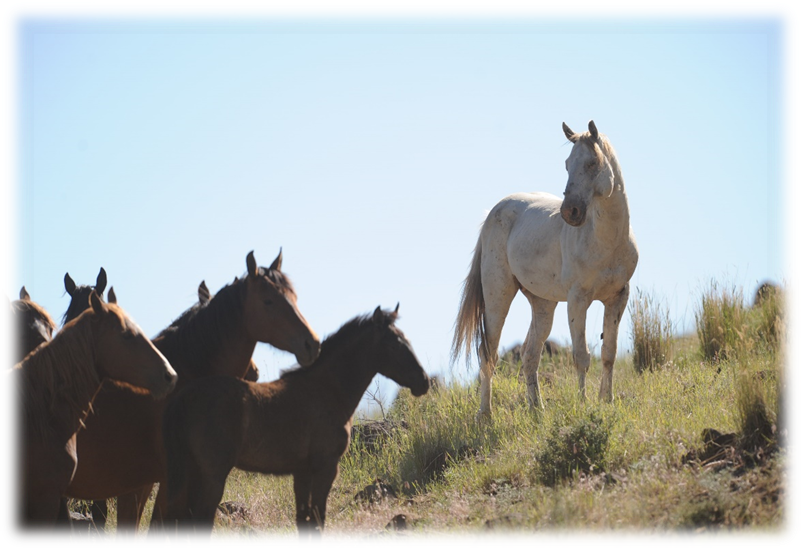
Wild Horse Photo by Leslie Sterling

Again, the Bureau of Land Management (BLM) annual population data exposes questionable inconsistencies including:

#1 Thousands of missing wild horses and burros from their legal home ranges

#2 Biologically impossible population increases

#3 Zeroing out and/or robbing the wild horses and burros from legally designated lands

Ten years ago, we started closely following the BLM’s annual published wild horse and burro population estimates; and have this data back even to 2005. What was found each and every year tells a troubling and often unbelievable story: population growth rates that defy biology and data that suggests the disappearances of thousands of wild horses and burros with no explanation. While the BLM claims to act in the animals’ best interest, its own records suggest a different narrative—one where numbers are manipulated, transparency is lacking, and the fate of thousands of wild horses and burros remains unknown.

Examples Below:

FORT SAGE Herd Management Area (HMA). BLM shows a 65% decrease in ONE year. During that one-year period, BLM reported no legal environmental assessment (EA) for any roundup of horses on this HMA and no legal roundup since September 1998. And yet the Fort Sage HMA is MISSING 283 of our wild horses this past year without any legally required notice (EA) to the public. These are our horses by congressional law and were SUPPOSED to be under the BLM’s protection.

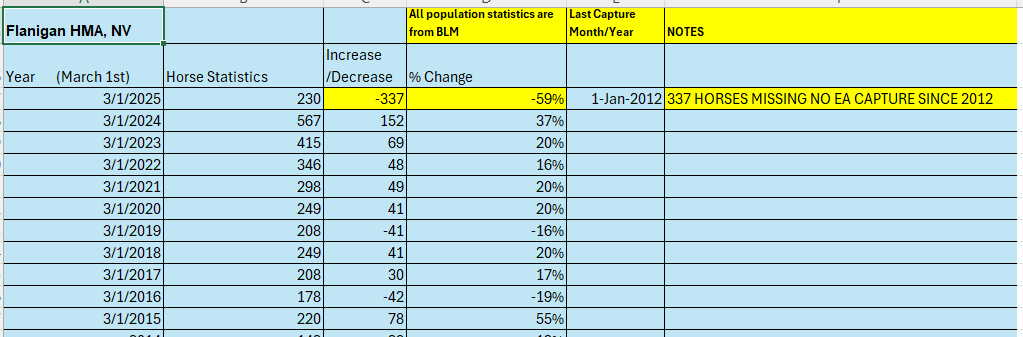
FLANIGAN Herd Management Area (HMA). BLM shows a 59% decrease in ONE year. During that one-year period, BLM reported no legal environmental assessment (EA) for any roundup of horses on this HMA and no legal roundup since annuary 2012. And yet the Flannigan HMA is MISSING 337 of our wild horses this past year without any legally required notice (EA) to the public. These are our horses by congressional law and were SUPPOSED to be under the BLM’s protection.

MONTGOMERY PASS Herd Management Area (HMA). BLM shows a 90% decrease in ONE year. Although a massive capture was planned for May of 2025, during that one-year period of March 2024 to March 2025, BLM reported no legal environmental assessment (EA) for any roundup of horses on this HMA and no legal roundup since September 1998. And yet the Montgomery Pass HMA is MISSING 666 of our wild horses this past year without any legally required notice (EA) to the public. These are our horses by congressional law and were SUPPOSED to be under the BLM’s protection.

BEATYS BUTTE Herd Management Area (HMA). BLM shows a 35% decrease in ONE year. During that one-year period, BLM reported no legal environmental assessment (EA) for any roundup of horses on this HMA and no legal roundup since June 2016. And yet the Fort Sage HMA is MISSING 232 of our wild horses this past year without any legally required notice (EA) to the public. These are our horses by congressional law and were SUPPOSED to be under the BLM’s protection.

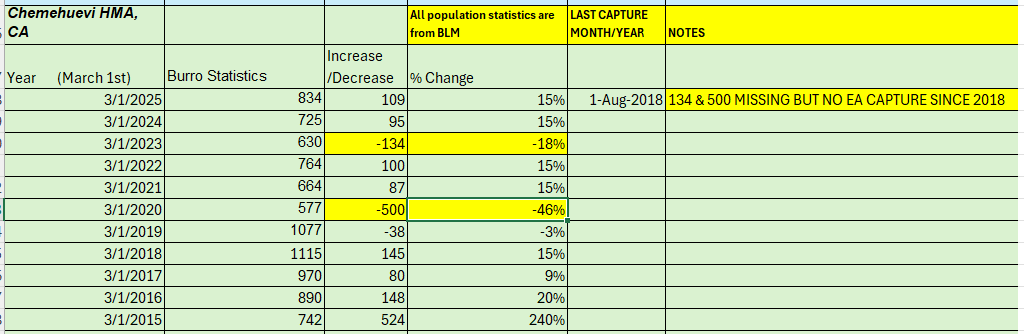
CHEMEHUEVI Herd Management Area (HMA). BLM shows a 46% decrease in ONE year. During that one-year period, BLM reported no legal environmental assessment (EA) for any roundup of burros on this HMA and no legal roundup since August 2018. And yet the Chemehuevi HMA was MISSING 634 of our wild burros in 2020 without any legally required notice (EA) to the public. These are our burros by congressional law and were SUPPOSED to be under the BLM’s protection.

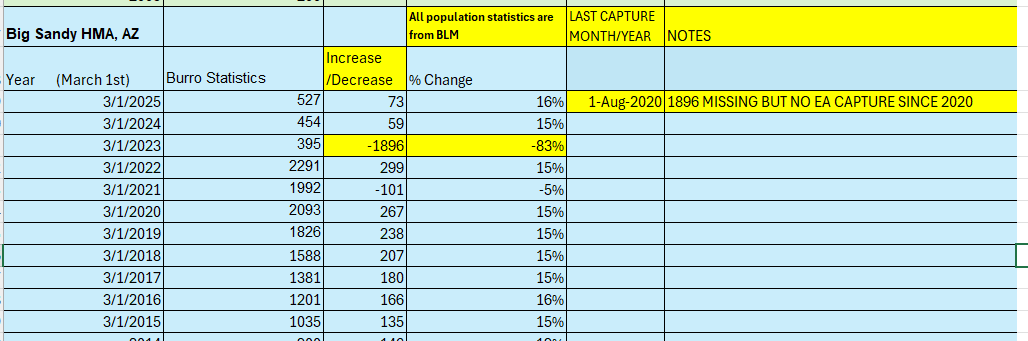
BIG SANDY Herd Management Area (HMA). BLM shows an 83% decrease in ONE year. During that one-year period, BLM reported no legal environmental assessment (EA) for any roundup of burros on this HMA and no legal roundup since August 2020. And yet the Big Sandy HMA was MISSING 1896 of our wild burros in 2023 without any legally required notice (EA) to the public. These are our burros by congressional law and were SUPPOSED to be under the BLM’s protection.

KIGER Herd Management Area (HMA) BLM shows a 140% increase in ONE year. This would require the herd of 224 horses to produce 314 successful foals in one year, meaning every single horse – including the stallions – have more than one surviving foal in one year. Biologically impossible

CIBOLA-TRIGO Herd Management Area (HMA) BLM shows a 699% increase in ONE year. This would require the herd of 279 burros to produce 1951 successful foals in one year, meaning every single burro – including the jacks – have more than six surviving foals in one year. Biologically impossible

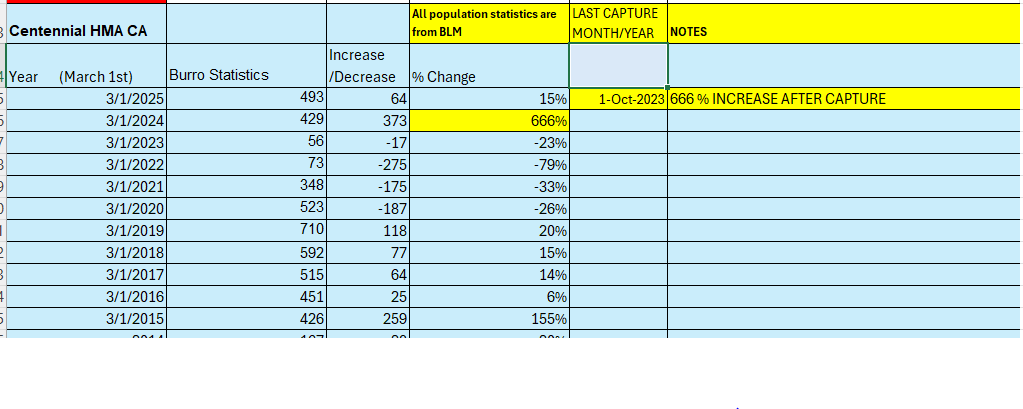
CENTENNIAL Herd Management Area (HMA) BLM shows a 666% increase in ONE year. This would require the herd of 56 burros to produce 373 successful foals in one year, meaning every single burro – including the jacks – have more than six surviving foals in one year. Biologically impossible

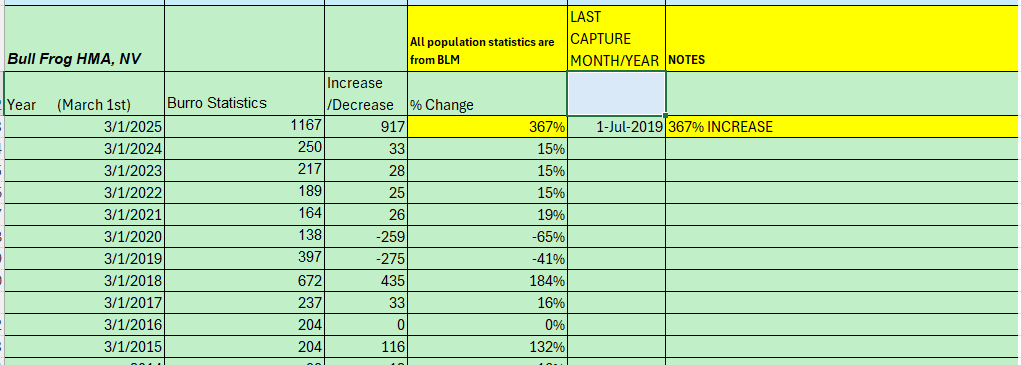
BULLFROG Herd Management Area (HMA) BLM shows a 367% increase in ONE year. This would require the herd of 250 burros to produce 917 successful foals in one year, meaning every single burro – including the jacks – have more than three surviving foals in one year. Biologically impossible

FOUR MILE Herd Management Area (HMA) BLM shows capturing 162 wild horses in 2021/22 followed by zeroing out the entire herd in 2024 due to fire although the Appropriate Management Area (AML) is still 37-60 and none have been returned to their legal land.

DIVIDE BASIN and SALT WELLS Herd Management Areas (HMAs) are being changed to Herd Areas (HAs) by BLM. Changing the designation from HMA to HA will allow the BLM to zero out all the wild horses. Furthermore, the captured and removed 2,485 wild horses will lose their legal protection as provided and stated in the 1971 Wild Horse and Burro Act.

STONEWALL Herd Management Area (HMA), NV. BLM shows 95 wild burros in March 2023 but then a year later March 2024 ALL burros were missing but the public was not notified and no legally required environmental assessment (EA) for capture was done by BLM resulting in zero burros on their legally land.

Legalities and Analysis:

Since 1971, the Wild Horse and Burro Act provides for the legal protection for these wild animals on specific acres of public lands. Because population estimates drive nearly all management decisions pertaining to wild horses and burros, accuracy is important. The National Academy of Science (NAS) report cited two chief criticisms of the Wild Horse and Burro Program: unsubstantiated population estimates in herd management areas (HMA), and management decisions that are not based in science (NAS, 2013). 

The annual population statistics published by the Bureau of Land Management (BLM), which have been the subject of public alarm, were officially reported on two separate occasions in recent years to the United States Office of the Inspector General (OIG). According to the office’s own guidelines, individuals with knowledge of fraud, waste, abuse, misconduct, or mismanagement involving the U.S. Department of the Interior are encouraged to contact the Office of Inspector General, yet in both instances, the Department declined to initiate an investigation and did not provide any explanation or justification for its decision.

The discovery of these questionable tactics by BLM raises serious issues regarding transparency and accountability. As demonstrated in the examples above, the data inconsistencies appear to have occurred over an extended period, suggesting a pattern that goes beyond isolated clerical errors.

Certain BLM statements presented regarding population increases and decreases appear to be inconsistent with available data, potentially leading to misunderstandings by Congress and the public. These discrepancies may raise concerns under federal statute Title 18 (18 U.S.C. § 1001), which addresses the prohibition against making false or fraudulent statements in matters within the jurisdiction of the federal government.

Specifically, 18 U.S. Code § 1001 outlines that knowingly and willfully falsifying, concealing, or covering up material facts, or making materially false statements in any matter within the jurisdiction of the executive, legislative, or judicial branches of the U.S. government, is a federal offense punishable by fines or imprisonment of up to five years. Additionally, such conduct may be at odds with the standards set forth in Executive Order 12674 on ethical behavior, which emphasizes the importance of integrity and public confidence in the actions of all federal employees.

Conclusion:

WHY is this evidence of BLM fraud so important? Because these deceitful statistics and maneuvers are provided by BLM to the public and delivered to Congress when BLM is requesting funding for wild horse and burro capture and management plans.

The discovery of

#1 Thousands of missing wild horses and burros from their legal home ranges

#2 Biologically impossible population increases

#3 Zeroing out and/or robbing the wild horses and burros from legally designated lands requires serious investigation.

We all need to voice our concerns by contacting the BLM and OIG. We must also continue to share this BLM dishonesty with our Senators and Representatives and the media and your friends – spread the word.

References:

2025 Wild Horse and Burro Population Estimates (blm.gov) https://app.box.com/s/n4anbas6y43ugb1rr5skComplaints & Requests | Office of Inspector General, U.S. Department of the Interior (doioig.gov)


Tags: , , , ,