An Editorial by John Cox, M.A. C/M

Mediocre Management is developed from bias, ignorance, lack of experience, and a non-completed fundamental education on the differences between mediocrity; or, knowing when your management paradigm is working, and how good does it work — compared to not working at all, or working half-assed.
It has become obvious many want to debate, or argue, things about Nature, that in reality simply do not exist; or exist, but only in their given area, where they camp perhaps a couple times a year, for example. I want to clarify Wilderness Areas, and in particular why we discuss Wilderness Areas within a complete separate context – primarily because Wilderness Areas are diverse in nature and natural surroundings. Here I will simply discuss the general Nature of the situation within management of our Natural Resources, and the boundaries bias, ignorance, and flawed decision-making generates.
When I discuss a Natural Area, or Wilderness Area, I mean an area of land or water dominated by native vegetation/wildlife and relatively undisturbed by human activity. Such areas could include grasslands, forests, wetlands, peatlands, or riparian areas. Areas such as groomed parks, sports fields, camping sites, and schoolyards are not natural areas.
Of specific Note here, ReWilding for example, is not based on Bias, or favored Wildlife to ReWild into a given area. ReWilding is more simplified, but education and experience dictates the level of management qualification, within the realms of research. This means the Wilderness Area, at one time was healthy, with its intermixed Natural situation of Terrestrial Ecology and Wildlife. A tropical Cascade of parameters met.
“Tropical cascade of wildlife” is not a formal scientific term, but rather, a descriptive phrase that helps develop the rich biodiversity and interconnectedness of life in tropical Wilderness Ecology, and Rainforests, Range Lands, and Coastal Zones, to name a few. . . The concept it most strongly relates to is a trophic cascade, an ecological phenomenon that describes the powerful effects organisms at one trophic level can have on others within an ecosystem. These effects can ripple both up and down the food chain, impacting populations and behaviors of various species.
As you can surmise here, bias, and ignorance of the area, or faulty research data within Terrestrial Vegetation and/or Wildlife, is a negative factor in the ReWilding phase. We see this ongoing today, among other factors I will not dwell into here, such as Group Hysteria we still see in Northern Catalonia within their bias and bigoted hatred toward Wolves (no evidence – no cause for their hysteria other than themselves), or hunter/trapper/ranchers referring to themselves as conservationists, that is until they speak about their conservation ideas (e.g. replaced “Killing Wildlife” with “Harvesting Wildlife”. making it sound as though their management of Wildlife productive — Overwhelming Evidence shows it is not productive at all).
We can use Wild Horses, or even Owls, as good examples, and their Birth Rates. Here in the Pacific Northwest, in the Siskiyou Mountains, we discover a diversity of occurrence. This is dependent upon the established Local Areas, or, to be more precise, Ecological Health. . .
We can see a Birth Rate of Spotted Owls, for example, and in a small parliament (i.e. A group of owls is most commonly called a parliament, less commonly a congress, stare, or hooting, all of which are related to owls’ characteristics), we find the overall environmental complex, or, ecology and predator prey relationships, can support 32 Owls; thereby, the birth rate can be, just as an example here, 30%, and inclusive of ecological health. And, as we discover through good data, and historical content as well, that it was a Spotted Owl in this specific area, that led to the very positive ReWilding Campaign to re-establish the Ecological Balance within this area.
Wild Horses also in the same area, as well as other browsers, and the association between Predator-Prey Relationships, Wolves & Bear & Cougar to name three, very well balanced — As good data gathering, interpretation of the data without bias, and allowing the data to speak for itself, and the know-how through experience to put it into action, and the first step forward to resolving issues within a desertified range land area, begins.
Fifteen to eighteen miles down the road, we can find yet another parliament of Spotted Owls, and yet, the ecological health lacks a healthy ecology. Humans have trapped, logged (e.g. hydraulic fluids and herbicides kill off underbrush) and presented pesticides and herbicides into the area. We then find out of a parliament of Spotted Owls, of 21, a birth rate of a mere 8% yearly, and declining. Needless to say, these Spotted Owls within this area will not be around for long, and will go extinct, in this area . . .
I will stop at two examples, as it becomes not so much standard, as each ecological area is much different, and yet possibly within the same forest. What we call Sky Islands, during the Plasticine Era, for example, had an entirely different, and much healthier ecological balance (i.e. wild horses and predator and prey relationships strong, as each existed very well among one another; whereas, the Wild Horses, for example, thrived well and did not die off. Although, 30 miles down the road, overlapping Glaciers may have been present, creating rolling foothills within the Cascade Mountain Range.
A good time to also state, there is no evidence to show us the Wild Horses simply disappeared 11,000 to 30,000 years ago, then reappear later. Our Universe and Wildlife Evolution, simply contradicts this human-made assumption, that Wild Horses are not Indigenous to the American West. Yet, the irony develops, decisions made about managing Wild Horses are taken from this opinion, and documented as if Science. Once again bigotry, bias, and hatred over any Wildlife, and suddenly the spirit of science neutralized.
This is just a rough explanation, that books could be written about – So I will leave you with the fact that not only are wildlife and land-mass different within a vast geological landscape, west coast to east coast, North and South, for example, but the ecological landscape and support of wildlife, remains much different within a few miles of each ecological habitat . . . One must use due diligence, the difference between a rank amateur that pretends to have a knowledgeable background, and those that do have the appreciate skills and background, remains how successful the Wilderness Area becomes. If we are looking at the facts, and we see 82% of our Public Lands “Desertified” over the past 12 years, we then know poor management the blame, and now, we should all know some of the reasons why. . .
The Columbia River, for example, between Oregon and Washington States, there exist 7 Major Ecological Zones. Each Ecological Zone breaks down into separate Wilderness Area Habitats, with each having a similar, but diverse, ecological-balance between wildlife, terrestrial vegetation, and types of species that can thrive well — or to the extreme, not at all, and all within several miles of one another.
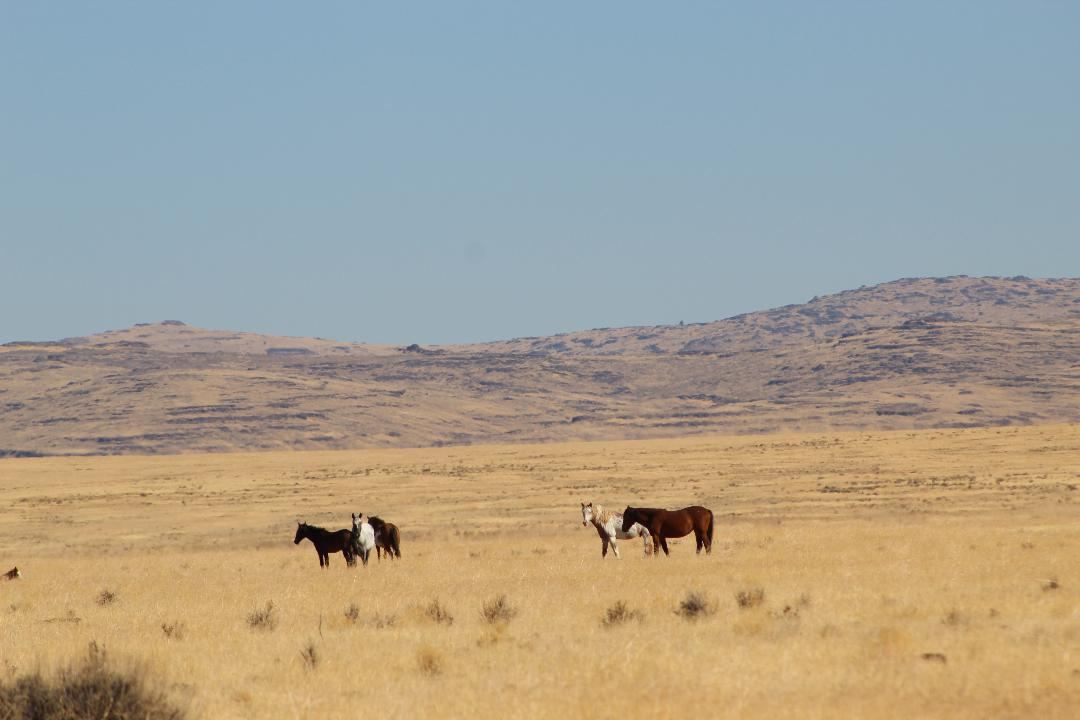
Within the Wild Horse context, we find similar situations. One Band of Wild Horses can remain very healthy, within a healthy ecology, and birth rates much higher than another Wild Horse Band 15 to 18 miles down the road; whereas, another band within another section of the HMA, may not be healthy at all, and within a poor to unhealthy ecological habitat, may develop such a poor birth rate, that sustainability is awkward at best. This is something our government, nor many advocacy groups of horse people, hunters, ranchers, et al., does not take responsibility for, as their science does not allow the facts to be given to the Public.
Our Lands and Wildlife need good management, not mediocre guess-work; whereas, information to act upon derived from good data gathering and highlighted by excellent management decisions made — proof positive, as evidence, when we see the Lands and Wildlife become healthy, again This means ReWilding was Successful, among other positive attributes.


 Photojournalist - Journalist